The $230 billion US physical security market1 has never had a single provider that owns the whole outcome – a managed service provider. In the first quarter of 2026, the company building one grew revenue 106%, turned gross margin positive for the first time, and put the last operational piece of its plan in place.2
Every few decades, an industry reaches a breaking point.
Costs spiral. Performance stalls. And no matter how much money gets thrown at the problem, the outcomes never seem to improve.
That moment has arrived for American security.
Crime costs the United States an estimated $2.6 trillion every year.3 Businesses pay between $220,000 and $570,000 per year to keep a single guarded post covered around the clock. Police coverage for one 24/7 post runs $438,000 to $1.3 million per year.4
And what do buyers get for all that spending? More than 90% of security alerts are non-actionable without a human in the loop (mostly false alarms).5 Guards, cameras, sensors, monitoring, and software all operate in silos. The average corporate security chief manages 8 to 12 vendors, and not one of them is accountable for the outcome.6
The guard company can’t see the cameras. The camera vendor can’t dispatch the guards. The AI tool can’t hear the radios. Every vendor sends a separate invoice. And when something happens at 3 a.m., nobody owns the phone call.
The system isn’t just inefficient. It’s broken.
Here is the part investors should pay attention to. This exact problem has been solved before, in a different industry.
Twenty years ago, IT security looked the same way: fragmented point products, no accountability, and frustrated buyers. Then the industry consolidated around the managed service provider (MSP) model, one provider owning the whole outcome under one contract. That shift minted an entire generation of category leaders.
Physical security never had its consolidation moment.
Until now.
A Silicon Valley security company, publicly traded on Nasdaq, is building the nation’s FIRST Autonomous Security Force: autonomous robots, AI-driven software, real-time monitoring, and licensed armed and unarmed security agents, all under a single managed service that is accountable for the outcome.7
That company is Knightscope, Inc. (NASDAQ:KSCP).
And the first quarter of 2026 is the moment the plan clicked into place. Revenue grew 106% year over year to $6.0 million. Gross margin turned positive for the first time. Roughly 70% of revenue is now recurring. And with the acquisition of Event Risk closed in February, all four operational pillars of the Autonomous Security Force are finally under one roof.8
As Chairman and CEO William Santana Li put it: “Q1 was a turning point for Knightscope. With the strategic acquisition of Event Risk, all four operational pillars of the Autonomous Security Force – autonomous machines, advanced software, real-time monitoring, and licensed security agents – are now in place.”9
What follows is the full story: the problem, the model, the numbers, and why Knightscope, Inc. (NASDAQ:KSCP) believes the next chapter is already in motion.
The Deadlock No One Could Break
America relies on roughly 1 million law enforcement professionals and 1.5 million security guards to keep people safe, supported by an estimated 100 million cameras that mostly go unwatched.10
All of it is human-centric. All of it is fragmented. All of it is reactive.
And hiring more people won’t fix it. Coverage scales with headcount, so costs rise in a straight line while outcomes stay flat. Cameras detect but don’t decide. Sensors alert but don’t respond. Most systems only get reviewed after something has already gone wrong.
CEO William Santana Li has been unusually blunt about the root cause. As he put it in a fireside chat this July, describing what he told the Department of Homeland Security, the Pentagon, and Congress: “This nation is addicted to three things: security guards, CCTV cameras, and video management systems running on Windows. And it does not want to change. Period. Full stop.”11
The graveyard of disruptors proves his point. By Li’s count, six companies have tried to do what Knightscope is doing, three of them major corporations and three of them startups. All of them failed, went bankrupt, or gave up.12 Hundreds more technology vendors have burned billions trying to sell point products into an industry whose buyers, mostly ex-FBI, ex-military, and ex-law enforcement, did not grow up with technology and have no reason to trust it.
The deadlock comes down to one word: accountability. Security buyers don’t buy technology. They buy outcomes. Traditional guard firms can patrol, but they cannot automate. Technology-only vendors can deploy robots, but they get disqualified the moment a client asks who owns the result.
Knightscope, Inc. (NASDAQ:KSCP) is the only provider built to do both.13
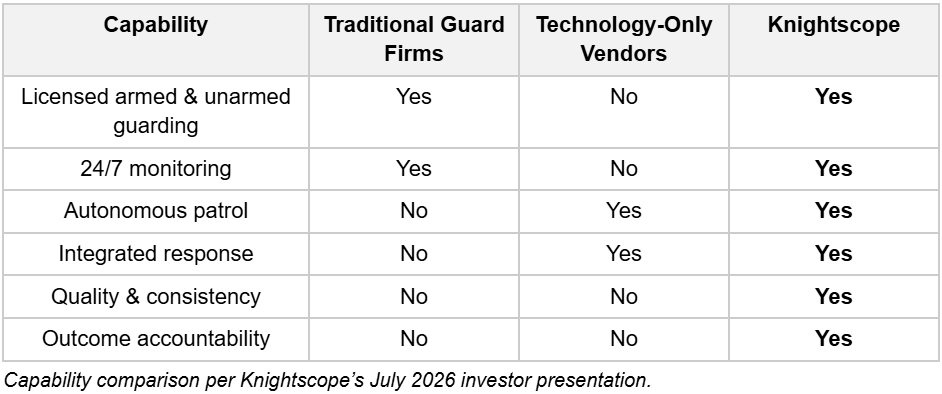
Guard firms check two boxes. Technology vendors check two. Knightscope, Inc. (NASDAQ:KSCP) checks all six. That is not a feature. It is the structural answer to the question every security buyer asks first: who is accountable?14
Press Releases
- Knightscope Details the Human Layer of the Autonomous Security Force
- Knightscope Introduces The Security Agent
- Knightscope Opens the Command Playbook of the Autonomous Security Force
- Knightscope Chairman and CEO William Santana Li to Present at Tribe Public Webinar Event on Thursday, September 10, 2026
- Knightscope Autonomous Security Force Extends to the Executive Suite
One Provider. One Platform. One Accountable Force.
The Autonomous Security Force is a single unified operation built to do three things at every site: deter, detect, and respond.15
Hardware handles persistent presence. Autonomous Security Robots and Emergency Communication Devices patrol and watch around the clock, providing visible deterrence that never takes a break.
Software handles the intelligence and orchestration. The Signals command-and-control platform fuses data from every machine in the network, prioritizes alerts so human operators are not drowning in noise, and orchestrates response in three dimensions using a digital twin of each site.16
Humans handle the judgment. The Mission Intelligence remote monitoring team verifies events around the clock, and Augmented Security Agents execute licensed, on-site response.
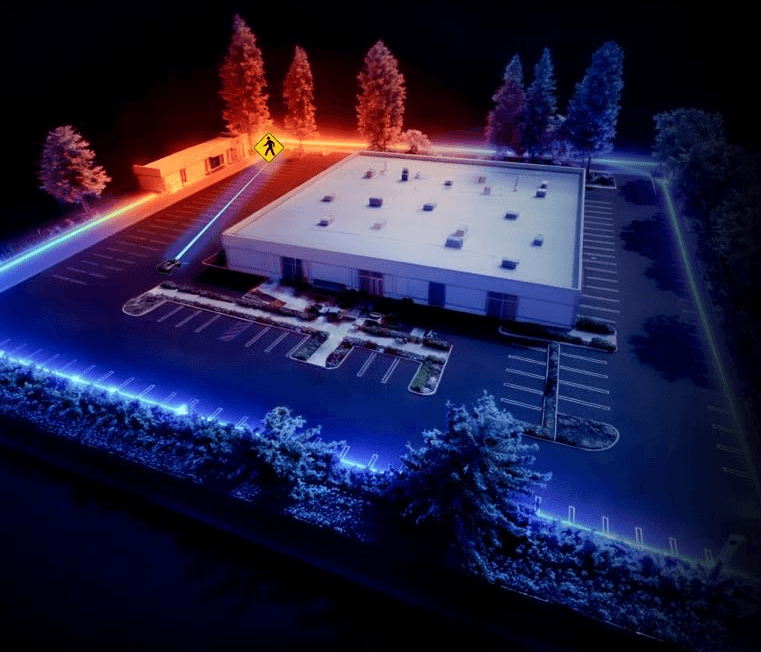
The Signals digital twin: a real-time, three-dimensional operational picture of an entire site, powering 24/7 monitoring and orchestrated response.
Source: Knightscope, Inc. Investor Presentation, July 2026
Tying it together is the ASF-7 escalation model: seven levels across three layers. Levels 1 through 3 run at machine speed, always on. Levels 4 and 5 add verified human judgment through Mission Intelligence analysts and supervisors. Levels 6 and 7 bring physical response through Augmented Security Agents and law enforcement engagement.17
Every patrol, sensor check, escalation, AI decision, and action is logged, timestamped, and auditable through the Signals intelligence layer.18 In an industry where nobody owns accountability, Knightscope, Inc. (NASDAQ:KSCP) built the audit trail into the product. As the company puts it: physical security has run on the “honor system” for thirty years. You paid for patrols and hoped they happened. Knightscope publishes the receipts, autonomously.19
And the receipts in the field are striking. At one commercial site, security incidents fell from 20 a month to one for the entire year. Another deployment recorded zero vehicle break-ins in ten months, down from one to two every week. A residential community that ranked top-three in its area for 911 calls dropped out of the top ten.20 The company’s own words: “We don’t trade on logos. We trade on receipts.”21
The Machines in the Field, and the Machines That Are Coming
The current fleet is already deployed and operational across the country, spanning healthcare, higher education, commercial real estate, manufacturing, hospitality, transportation, and government.22
The K5 Autonomous Security Robot is the workhorse. It delivers continuous, autonomous patrol across structured outdoor environments like parking lots, campuses, and walkways, combining intelligent sensing with a highly visible presence that strengthens coverage without adding headcount.23
The K1 Hemisphere secures entry points and high-risk micro-locations as a stationary, high-visibility device. The K1 Blue Light Tower, E-Phone, and Call Box family covers emergency communication across universities, hospitals, transit hubs, and public spaces nationwide. These are not passive devices. They are connected nodes being set up to feed real-time data back into the Signals platform.24
The next generation arrives in the second half of 2026. The all-new K1 Capsule brings blue-light technology into a compact form factor with AI analytics and 360-degree video. The all-new K1 Super Tower, available in 7, 14, and 21 foot versions, takes the emergency communication concept to commanding scale for large outdoor areas, perimeters, and critical infrastructure.25
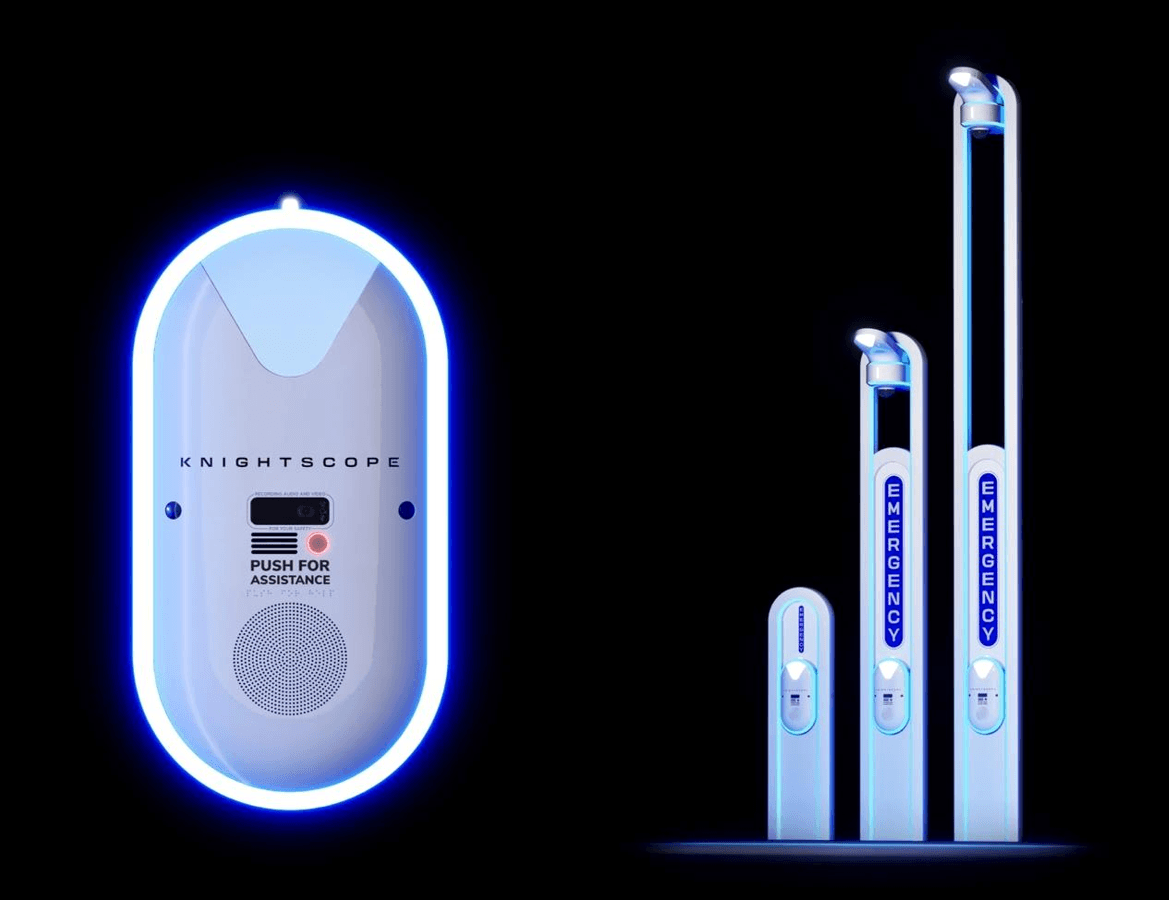
The all-new K1 Capsule (left) and K1 Super Tower (right): next-generation emergency communication, from compact blue-light form factor to commanding 21-foot presence.
Source: Knightscope, Inc. Investor Presentation, July 2026
The K7: The Flagship of the Force
If you visit knightscope.com today, one machine dominates the screen. It fills the hero image, anchors the motion graphics, and headlines the company’s September unveiling. That machine is the all-new K7 Autonomous Security Robot, and it is the boldest product Knightscope, Inc. (NASDAQ:KSCP) has built since its founding in 2013.26

The all-new K7 Autonomous Security Robot: next-generation, large-area autonomous patrol for perimeters no camera or human post can match.
Source: Knightscope, Inc. Investor Presentation, July 2026
Unveiled in November 2025, the K7 is engineered to patrol vast outdoor areas 24/7, combining light-duty, off-road performance with Knightscope’s (NASDAQ:KSCP) proven suite of AI-powered detection, deterrence, and reporting technologies. As Li said at the unveiling: “We designed it to secure environments previously considered too large, too remote, or too dangerous for conventional solutions – and to do so reliably, affordably.”27
Think about what that unlocks. Miles of fence lines. Logistics hubs. Industrial complexes. Solar and wind farms. Critical infrastructure. Defense installations. These are environments where human patrol is impractical, fixed cameras are insufficient, and demand for autonomous coverage is growing fast. Every market the K7 opens is a new layer of recurring revenue sitting on top of the existing base.28
The rollout is deliberate. A public waitlist is open at knightscope.com/K7, with early participants gaining priority access to limited series production expected to begin deployment in the second half of 2026.29 Li has been explicit about the approach: “We’re taking a disciplined approach to market introduction. Our focus is on client success and demonstrating how autonomous security can solve challenges in real world operations.”30
The engineering pipeline behind it is just as serious. The K7 is undergoing electromagnetic-compatibility testing as part of the company’s federal-grade engineering standards,31 and five graduate students from Carnegie Mellon’s Robotics Institute are already building an advanced AI feature for the platform under the company’s five-year university collaboration.32
And the stage is set. The Autonomous Security Force, with the K7 front and center, debuts at GSX 2026 in Atlanta, September 14-16, at Booth 3905, inside an appointment-only Signals VIP Room.33 For a company this size, a flagship product launch at the industry’s biggest security show is exactly the kind of catalyst that puts a story on new radars.
Q1 2026: A Step-Up in Revenue, and a First for the Company
Talk is cheap in the investment world. What matters is execution. Here is what the numbers show.
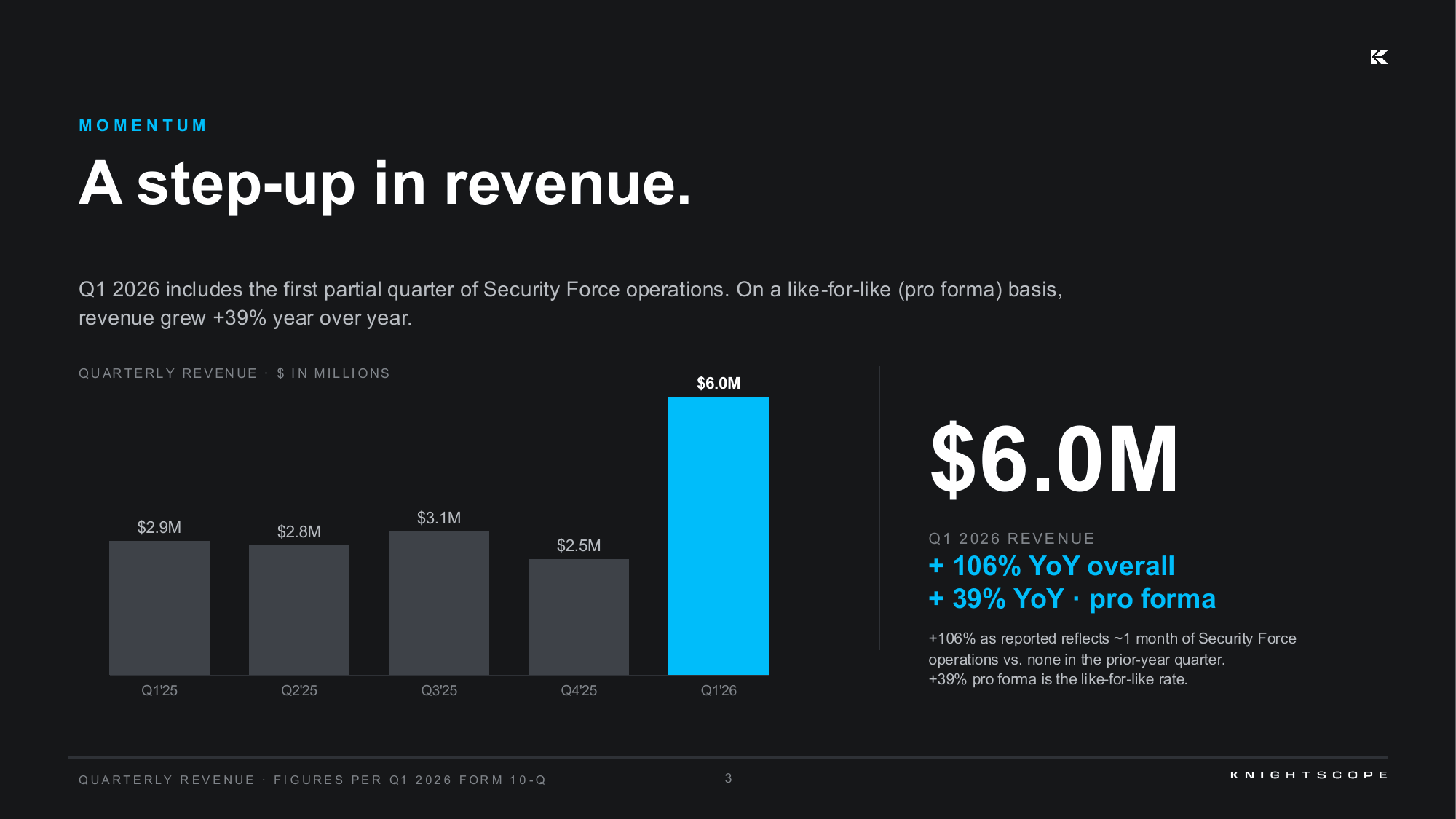
Quarterly revenue stepped up to $6.0 million in Q1 2026, the company’s strongest quarter to date.
Source: Knightscope, Inc. Investor Presentation, July 2026
In the first quarter of 2026, Knightscope, Inc. (NASDAQ:KSCP) reported $6.0 million in revenue, up 106% from $2.9 million in the prior-year period. Service revenue grew 98% to $4.2 million, including roughly $2.4 million from one month of Knightscope Security Force operations. Product revenue climbed 128% to $1.8 million as the company fulfilled Emergency Communication Device orders previously held back by supply chain constraints.34
Two details in that report matter more than the headline number.
First, gross margin turned positive at $0.5 million, or 8% of revenue, compared with a gross loss in the prior-year period. For a company that spent years investing ahead of scale, crossing that line is a structural signal, not a rounding error.35
Second, approximately 70% of Q1 revenue was recurring service revenue.36 Managed services businesses are valued on exactly that: recurring mix and retention. On a like-for-like, pro forma basis, revenue still grew 39% year over year, meaning the underlying business was growing well before the acquisition math kicked in.37
For context, full-year 2025 revenue was $11.3 million, with service revenue at roughly 70% of the total.38 The first quarter of 2026 alone delivered more than half of last year’s annual revenue. And because the Event Risk acquisition closed in late February, Q1 captured only about one month of Security Force operations. The second quarter will be the first to show a full quarter of the combined company.39
The momentum did not stop at the quarter’s end. In May, Knightscope, Inc. (NASDAQ:KSCP) announced approximately $3.8 million in new and recurring contracts across eight verticals, led by critical infrastructure. The client list reads like a cross-section of American operations: a major California county government, the federal government, metropolitan law enforcement and emergency response agencies, a US national laboratory, regional transit, aviation and port authorities, Fortune 500 pharmaceutical and healthcare organizations, and national retail brands.40
“Clients across the country are tired of buying products and getting fragmented results. They want outcomes, and they want one accountable provider. That is exactly what we are building: one provider, one platform, one accountable force.” – William Santana Li, Chairman and CEO41
The Acquisition That Completed the Force
For years, the missing piece of the model was licensed guarding: the capability that wins RFPs, satisfies regulators, and puts trained humans on-site when judgment is required.
In February 2026, Knightscope, Inc. (NASDAQ:KSCP) closed the acquisition of Event Risk, a nationwide provider of armed and unarmed security guarding and executive protection with consistent double-digit growth, strong client retention, and established relationships with Fortune 1000 companies, national brands, and high-profile individuals.42 The acquisition, valued at approximately $18.0 million, was the culmination of a deliberate strategy: earlier in the quarter, the company had retained Lake Street Capital Markets as its exclusive buy-side advisor to target profitable, cash-flowing guarding businesses.43
The business is being rebranded as the Knightscope Security Force, and its founder, Eric J. Rose, joined the leadership team as President, Security Force. Rose’s background spans Apple, Madison Square Garden, and Pinkerton, and he served as a trainer for the U.S. Marine Corps and Navy SEALs.44
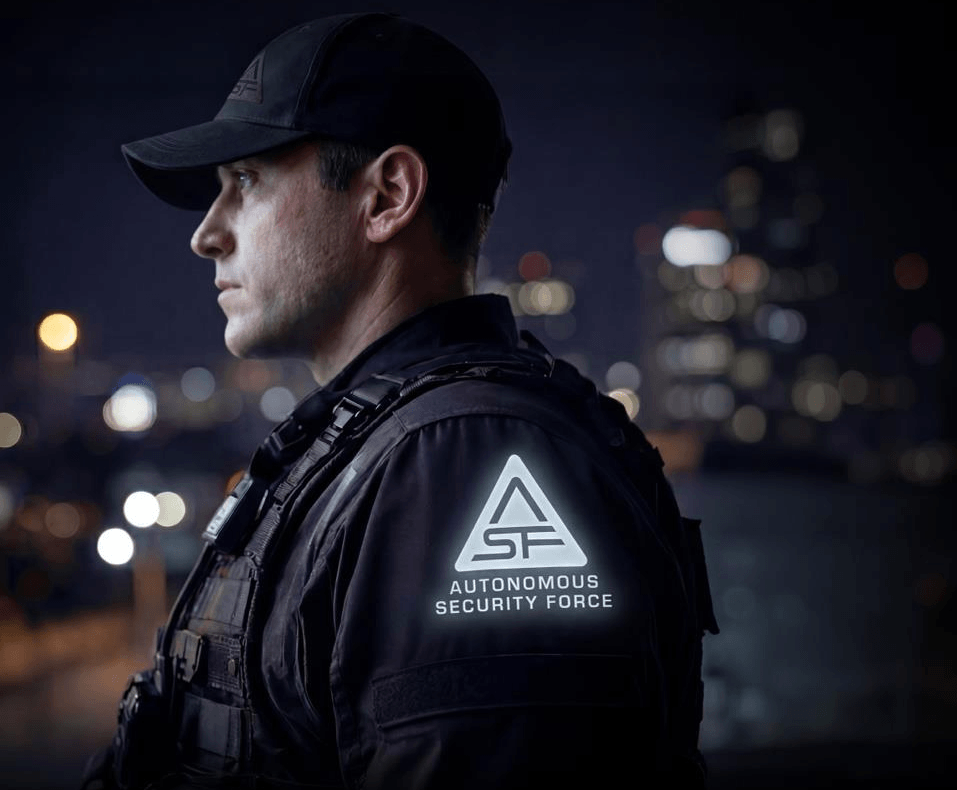
In connection with the deal, the company quadrupled its workforce to over 400 people, including 290 security agents supporting client deployments nationwide, and began offering equity participation to frontline security agents, a structural differentiator in an industry known for extreme turnover.45 Hiring has continued since: in July, the company announced another significant workforce expansion, adding 136 employees across security, supervisory, and operations roles.46
If the acquisition seemed strange from the outside, a Silicon Valley robotics company buying an armed and unarmed guarding business, Li’s explanation makes the logic hard to argue with. Only one municipality in the entire United States has ever put out a request for proposal for security robots. Every other RFP in the industry is written the same way: 72 cameras, 32 guards, 10 officers – never robots.47
So rather than wait for the industry to change its paperwork, Knightscope changed its entry point. As Li put it: “These people don’t want to change. Okay, so I’m going to put this in a format that you’ll accept.”48 Guards go in first. Trust gets earned. Then expenditures come down, outcomes improve, and the technology layers in, with Knightscope, Inc. (NASDAQ:KSCP) as the managed service provider delivering the correct combination of hardware, software, and humans for each client’s location, problem, and budget.49
Here is why the deal matters strategically. Every guarding contract Knightscope, Inc. (NASDAQ:KSCP) holds is a future deployment channel for autonomous machines. Traditional guards become Augmented Security Agents. Static posts get replaced by robots over time as the technology proves itself, site by site.
Guards are not the destination. They are the deployment catalyst for autonomy.
The Growth Math Hiding Inside 434 Clients
Knightscope, Inc. (NASDAQ:KSCP) today serves 434 clients across 42 states and 8 verticals, with more than 10,000 machines in its network and over 4.4 million autonomous hours logged and counting.50
Most investors would assume the growth story requires winning the whole $230 billion market. It doesn’t. It requires growing inside accounts the company already has.
Across its top five Security Force clients alone, the company estimates more than $850 million in annual security spend. Knightscope’s share of that spend today is less than 2%.51 That is a 98%+ in-account runway before the company knocks on a single new door. Land the contract with guarding. Expand with monitoring, machines, and software. Own more of the outcome each year.
There is a second runway most investors miss entirely: the installed base. An estimated 200,000+ legacy blue-light towers are already deployed across the United States, and Knightscope, Inc. (NASDAQ:KSCP) has a retrofit path to bring them onto the Signals platform.52 Every retrofit turns a decades-old emergency phone into a connected node in the network.
The business model behind all of it is Machine-as-a-Service (MaaS): a bundled, recurring subscription that combines hardware, software, and human support under one contract. Recurring revenue for a recurring societal problem.53
The company is candid about how the economics are designed to evolve, and it is worth quoting the logic plainly. Robots and software carry near-zero marginal cost, so margin structure improves as autonomy density rises per site. Roughly 70% of revenue is already recurring. And robots replace static posts one at a time, so revenue per site can rise without matching headcount. The destination is an operating model where revenue scales faster than cost. The company frames that as the thesis behind the levers, not guidance,54 and that kind of directness is worth noting in a market full of overpromises

The K7 on perimeter patrol at a critical infrastructure site: miles of fence line, covered autonomously, around the clock.
The Next Chapter Is Already in Motion
Four named catalysts are on the calendar, and each one compounds the others.
-
-
- The all-new K7 Autonomous Security Robot. The flagship of the Force, covered in depth above: waitlist open, limited-release beta deployments planned for the second half of 2026, and the centerpiece of the GSX 2026 debut in September.55
- Signals, the AI command platform. The digital twin powering 24/7 Mission Intelligence operations, with sensor fusion, alert triage, and orchestrated response. Also showcasing at GSX 2026.56
- The H1 Augmented Security Agent. A tech-enabled wearable prototype, exclusive to Knightscope Security Force agents, designed to make every human post a force multiplier – and a node on the Signals platform. Also showcasing at GSX 2026.57
- Security Force expansion and federal-grade hardening. Land-and-expand inside the existing 434 clients, where the company holds less than 2% of an estimated $850 million-plus in annual in-account security spend, while hardening the platform to U.S. government cybersecurity standards that point-vendors cannot claim.58
-
And behind the product roadmap sits a research pipeline. In April 2026, Knightscope, Inc. (NASDAQ:KSCP) entered a five-year letter agreement with Carnegie Mellon University’s School of Computer Science, one of the most respected robotics institutions in the world. Five graduate students from CMU’s Robotics Institute are already working with Knightscope on an advanced AI feature for the K7, and the company is making its National Security Robotics Lab in Silicon Valley available to the university.59
The playbook here has a proven arc in the public markets: hardware on the ground, then a software and subscription network on top, then ownership of the category. One public safety technology company already ran that arc for law enforcement and built one of the most valuable franchises in the sector. Knightscope, Inc. (NASDAQ:KSCP) is running the same model in physical security operations: machines and agents on the ground, Signals on top, one recurring contract per site.60
Who Owns Your Security Provider?
Here is a question most security buyers never think to ask, and it is becoming one of the most important in the industry.
Patrol patterns, access records, exposure blueprints, and trade secrets all flow through a security provider. Yet the three largest guarding companies operating in the US, which Li estimates generate $20 to $30 billion in annual US revenue and employ roughly half a million people, are all foreign owned or controlled in some form.61 Private-equity held with foreign pension funds as largest shareholders. Listed abroad under foreign family holding companies. Privately held overseas.62
Li does not soften the implication: “They know your exposure, they know where all your risks are, they know all your patrols, they know everything. And you’re telling me that’s okay? I’m sorry, on my watch that’s not okay.”63
Knightscope, Inc. (NASDAQ:KSCP) is the only American, publicly traded company in autonomous security. US-only operations. No foreign parent. American-controlled end to end.64 In an era of rising scrutiny on foreign control of critical infrastructure, that is not a marketing line. It is a procurement advantage. Built in America to secure America.
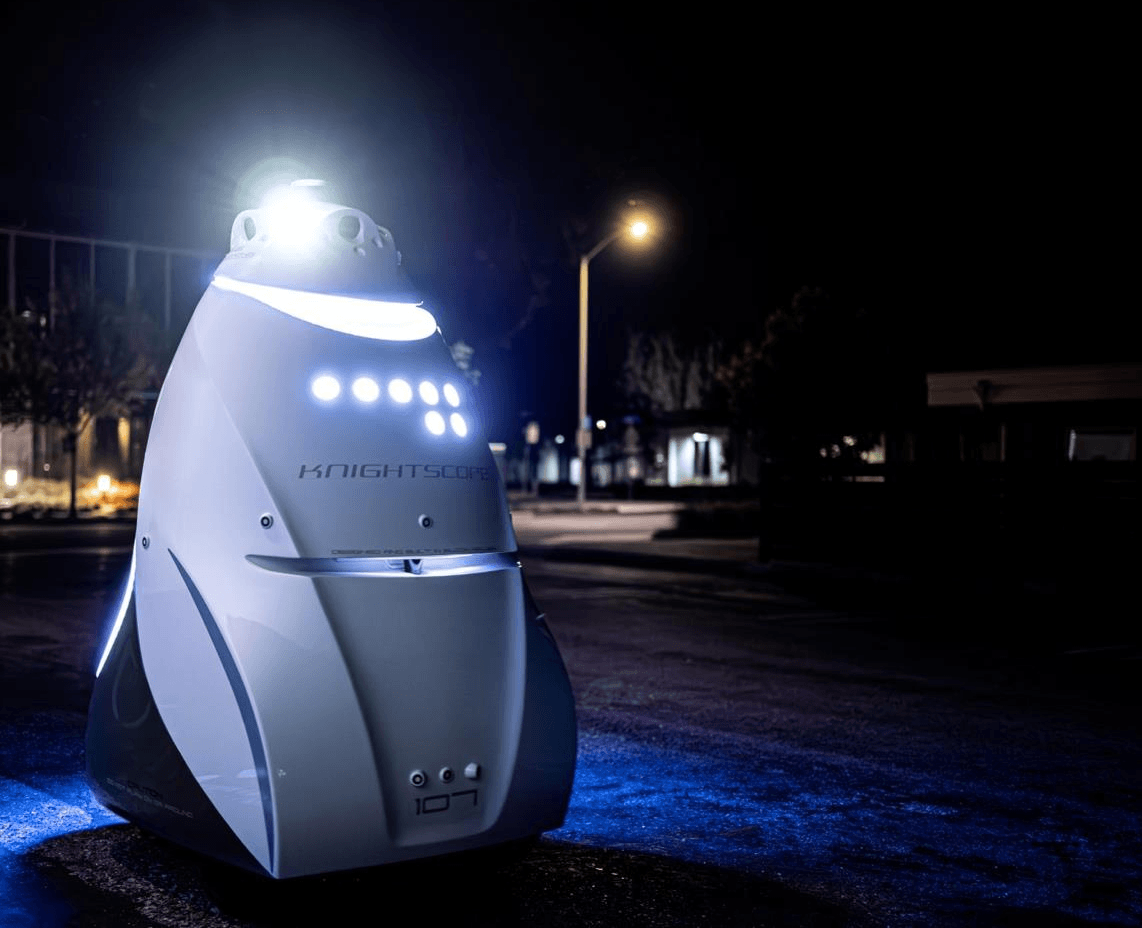
The K5 Autonomous Security Robot on patrol. Approximately 10,000 machines and agents are already deployed in the Knightscope network.
8 Reasons
Investors Are Paying Close Attention to Knightscope, Inc. (NASDAQ:KSCP) Right Now
1
A $230 Billion Market That Never Had Its Consolidation Moment. Physical security is one of the largest and least disrupted industries in America, spanning government, healthcare, education, retail, critical infrastructure, and residential communities.65 IT security consolidated to the managed-service model twenty years ago and minted category leaders. Physical security never did. Knightscope, Inc. (NASDAQ:KSCP) is building that consolidation: one provider, one contract, one accountable force.
2
Revenue Grew 106%, and Gross Margin Turned Positive for the First Time. Q1 2026 revenue came in at $6.0 million, up from $2.9 million a year earlier, with service revenue up 98% and product revenue up 128%. Gross margin reached 8% of revenue, compared with a gross loss in the prior-year period.66 Even on a like-for-like pro forma basis, revenue grew 39%.67
3
Roughly 70% Recurring Revenue Across 434 Clients in 42 States. $4.2 million of the $6.0 million Q1 revenue was recurring service revenue.68 Managed services businesses are valued on recurring mix and retention, and many Knightscope, Inc. (NASDAQ:KSCP) clients have renewed their subscriptions for years running.
4
The Only Provider That Checks All Six Boxes. Licensed guarding. 24/7 monitoring. Autonomous patrol. Integrated response. Quality and consistency. Outcome accountability. Traditional guard firms check two. Technology-only vendors check two. No other company delivers all six.69
5
The Acquisition That Completed the Force Is Closed and Operational. Event Risk brought licensed armed and unarmed guarding, executive protection, Fortune 1000 relationships, and immediate revenue.70 The workforce has quadrupled to over 400, frontline agents are receiving equity, and hiring continued into July with 136 additional employees.71
6
A Next-Generation Platform Deploying in the Second Half of 2026. The all-new K7 Autonomous Security Robot, K1 Capsule, and K1 Super Tower are slated for limited release, all integrated with the AI-driven Signals platform, with the K7, Signals, and the H1 wearable showcasing at GSX 2026 in September.72 A five-year Carnegie Mellon collaboration is feeding advanced AI work directly into the K7.73
7
A 98%+ In-Account Runway Before Winning a Single New Client. Across its top five Security Force clients, Knightscope, Inc. (NASDAQ:KSCP) holds less than 2% of an estimated $850 million-plus in annual security spend.74 Add a retrofit path for 200,000+ legacy blue-light towers in the US installed base, and the land-and-expand thesis writes itself.75
8
Three Analysts. All BUY. Targets From $8 to $25. Lake Street Capital Markets, HC Wainwright, and Ascendiant Capital all cover the stock with BUY ratings.76 And in June 2026, the board tied multi-year executive performance awards to market capitalization milestones of $500 million to $3 billion, aligning management pay directly with shareholder outcomes.77
How the Market Values It Today
One of the most useful ways to evaluate any opportunity is to line the company up against its peers in public safety and physical security technology.
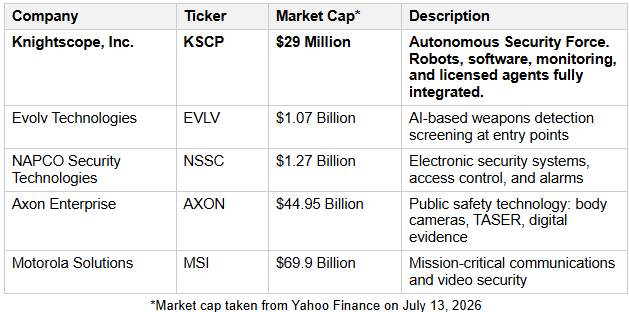
The context makes the gap striking. Evolv Technologies does one thing, detecting weapons at entry points, and carries a valuation over $1 billion.78 It does not patrol. It does not respond. It does not own end-to-end accountability.
Axon Enterprise, widely considered the gold standard in public safety technology, built a business worth tens of billions by running the exact hardware-to-software-subscription arc described above, for law enforcement. Knightscope, Inc. (NASDAQ:KSCP) is running that arc for physical security, at a market capitalization of roughly $29 million against an estimated $230 billion US addressable market.79
Wall Street has started to notice. Three research analysts cover the stock: Lake Street Capital Markets, H.C. Wainwright, and Ascendiant Capital. All three rate it a BUY, with published price targets ranging from $8 to $25.80
And there is one more alignment signal worth flagging. In June 2026, the board approved amended executive employment agreements that tie multi-year performance awards to market capitalization milestones of $500 million, $1 billion, $2 billion, and $3 billion, along with corresponding revenue and adjusted EBITDA targets.81 Management does not get paid those awards unless shareholders get there first.
To be clear about the other side of the ledger: Knightscope, Inc. (NASDAQ:KSCP) is not yet profitable, is investing ahead of scale, and reported $11.4 million in cash as of March 31, 2026.82 This is an execution story, and execution stories carry risk.
Li himself frames it in exactly those terms. Market risk? “Do you think the market for crime is going to evaporate tomorrow? You’ve got a recurring revenue business model for a recurring societal problem. No market risk.”83 Technology risk? The machines have operated 4.4 million hours fully autonomously since the first deployment on May 4, 2015.84 What’s left is execution risk, and his answer to that is the one every investor should watch: “Best way to reduce execution risk? Brilliant people.”85
Operators Who Have Scaled Before
Great technology needs great leadership. This team has built, financed, and scaled complex operations before.
The board adds federal and autonomy depth: Robert A. Mocny, a former Department of Homeland Security senior executive who helped lead national biometric and border security programs after 9/11; Melvin W. Torrie, founder and CEO of Autonomous Solutions Inc., whose vehicle automation clients have included NASA, Toyota, and Komatsu; and William G. Billings, former Chief Accounting Officer at GlobalFoundries with senior finance roles at Airbnb and GE.
This is not a team assembled for a press release. It is a team assembled to win.
The Window Is Open. It Will Not Stay That Way.
Every major technology shift has a moment when the model is proven but the market has not fully caught on. When the revenue is real but the valuation has not caught up.
For Knightscope, Inc. (NASDAQ:KSCP), the evidence says that moment is now. Revenue grew 106% in Q1 2026, with gross margin positive for the first time.87 Roughly 70% of revenue is recurring.88 All four pillars of the Autonomous Security Force are in place. $3.8 million in fresh bookings landed in May across eight verticals.89 The K7, Signals, and H1 all showcase at GSX in September, with K7 beta deployments planned for the second half of 2026.90 And the second quarter will be the first to reflect a full quarter of the combined company.91
Meanwhile, the stock trades at a market capitalization around $29 million92 against a $230 billion addressable market,93 with three analysts rating it a BUY at targets of $8 to $25.94
In April, the company hosted its first Autonomous Security Force Day, putting the model in front of a room full of chief security officers and security professionals. Li’s summary of the pitch doubles as the simplest version of the investment case: “Tell me which chief security officer is going to say, no, I don’t want a better team and better technology and lower cost and better quality. Nobody.”95
Security is not going away. Crime is not going away. And the demand for smarter, faster, more accountable protection is only going to grow. Knightscope, Inc. (NASDAQ:KSCP) is the only company in America positioned to deliver all of it under one roof.
Security. Handled.96
To learn more about Knightscope, Inc. (NASDAQ:KSCP) and access the full investor presentation, subscribe here.