
On March 17, 2026, a tiny drone-software startup called Swarmer (NASDAQ:SWMR) went public at $5 per share. Within 48 hours, it was trading at $55, a staggering 1,100% gain. The best IPO debut since Newsmax’s 2,230% pop last year. Volatility halts triggered multiple times. Wall Street went ballistic.¹
Headlines screamed. Analysts scrambled. Retail investors piled in. And by the time the dust settled, Swarmer had a market cap that surged past $680 million.²
For a company that reported just $309,920 in total revenue for all of 2025, down 6% from the year before, with a net loss of $8.5 million and substantially all of that revenue coming from a single customer in Ukraine.³
But here is what those breathless headlines completely missed.
Swarmer is software. Its entire business, coordinating AI-powered drone swarms, works only when drones have somewhere to launch from. Somewhere with power. With mobile communications. With real-time surveillance and command infrastructure. Without the physical infrastructure layer, drone swarms are just code without a backbone.
Critical Infrastructure Technologies Ltd. (CSE:CTTT) (OTC:CITLF) builds exactly that backbone. Self-deploying, self-powering field infrastructure towers that unfold in 30 minutes, run off-grid for months, and carry radar, ISR sensors, 5G, drone launch platforms, and counter-drone payloads. Already deployed with the Australian Department of Defence. Already ordered by the Ukrainian Ministry of Defence. Already generating real customer revenue.
And on the day Swarmer hit $680 million on $309,920 in annual revenue, a single customer, and a software platform with no physical assets, CiTech (CSE:CTTT) (OTC:CITLF) was sitting at roughly $49 million. With hardware in the field. With a FTSE 100 defense partner. With NATO country manufacturing partnerships. With sovereign government funding.
Something in these numbers does not add up.
And that gap is exactly the opportunity.
Defense Stocks Have Already Made a Generation of Wealth in 12 Months. The Next Wave Is Autonomous Infrastructure
On January 7, 2026, the White House called for the largest defense budget in American history: US$1.5 trillion for fiscal year 2027, a 66% increase from current levels.⁴ The market had already been voting
Kratos Defense (NASDAQ:KTOS) soared 196% in 2025 and climbed another 52% in the past month alone, now up nearly 300% over the trailing twelve months.⁵
AeroVironment (NASDAQ:AVAV), the leader in military drones, gained 76.6% in 2025 as demand for unmanned systems exploded.⁶
RTX (NYSE:RTX), parent of Raytheon, climbed 60% through 2025 to all-time highs near US$185, fueled by a book-to-bill ratio of 2.27, meaning new orders were running at more than double shipments.⁷
Lockheed Martin (NYSE:LMT) jumped 13.7% in just the past month, driven by record F-35 deliveries and a historic PAC-3 missile production deal.⁸
Northrop Grumman (NYSE:NOC) broke out to new all-time highs above US$660, with UBS raising its price target to US$777.⁹
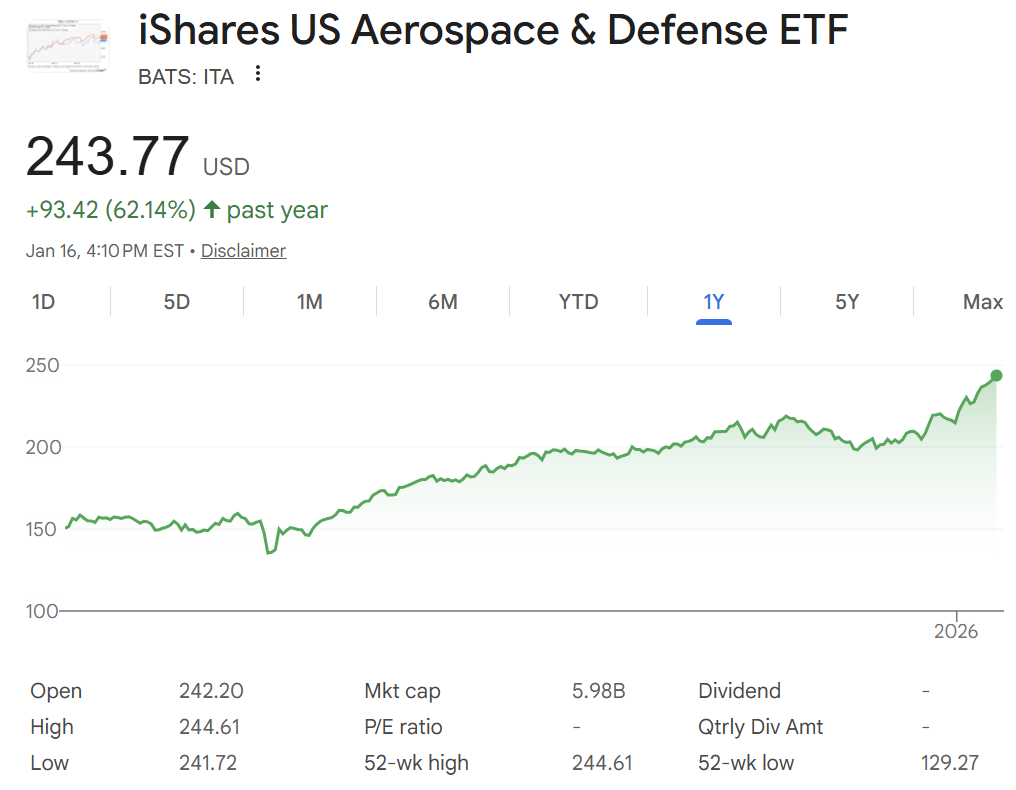
And the iShares US Aerospace & Defense ETF (ITA) returned 48.64% in 2025, nearly doubling the S&P 500’s performance, and has now delivered a 62% total return over the trailing twelve months.¹⁰
Now add Swarmer’s explosive IPO to that list. The market is sending a crystal-clear signal: defense technology, especially autonomous systems, is the investment theme of 2026. This is not a one-day bounce. It is a sustained, accelerating repricing of every company that touches battlefield technology.
The geopolitical backdrop makes it inescapable. China conducted its “Justice Mission 2025” exercise, crossing into Taiwan’s contiguous zone for the first time.¹¹ The war in Ukraine continues to stretch NATO supply chains.¹² US-Iran tensions are flaring. As one analyst put it: “Geopolitics is the inescapable story of 2026.”¹³
The signal is clear. Defense is the sector of 2026. But the most sophisticated investors are not chasing the same Lockheeds and Northrops. They are looking one layer deeper.
Because behind every drone swarm, every missile system, every border surveillance network, every forward operating base is something most investors never think about: the infrastructure that makes it all work.
The towers. The power. The signal. The sensors. And increasingly, the autonomous systems that deploy themselves in minutes, not weeks. That is where Critical Infrastructure Technologies Ltd. (CSE:CTTT) (OTC:CITLF) is positioned. At the exact intersection of the robotics boom and the defense surge.
When Communications Infrastructure Fails, Entire Missions Collapse: Here Is the $165 Billion Problem That Nobody Solved Until Now
When comms go down, everything breaks.
Defense teams lose coordination. First responders go dark. Mining operations halt. A single blackout can stop an entire mission cold. This is not a fringe problem. It is the central constraint of modern defense and emergency response. And it is precisely what CiTech (CSE:CTTT) (OTC:CITLF) was engineered to solve.
The evidence is everywhere. Hurricane Helene knocked out 66% of cell sites across the Carolinas.¹⁴ A Russian missile collapsed a 240-meter broadcast tower in Kharkiv in seconds.¹⁵ When storms or strikes hit, fixed infrastructure fails first. Always.
Traditional towers need cranes, technicians, generators, and grid power. They take weeks to install. They cannot move when the mission shifts. They require permanent foundations. They are, by design, immovable.
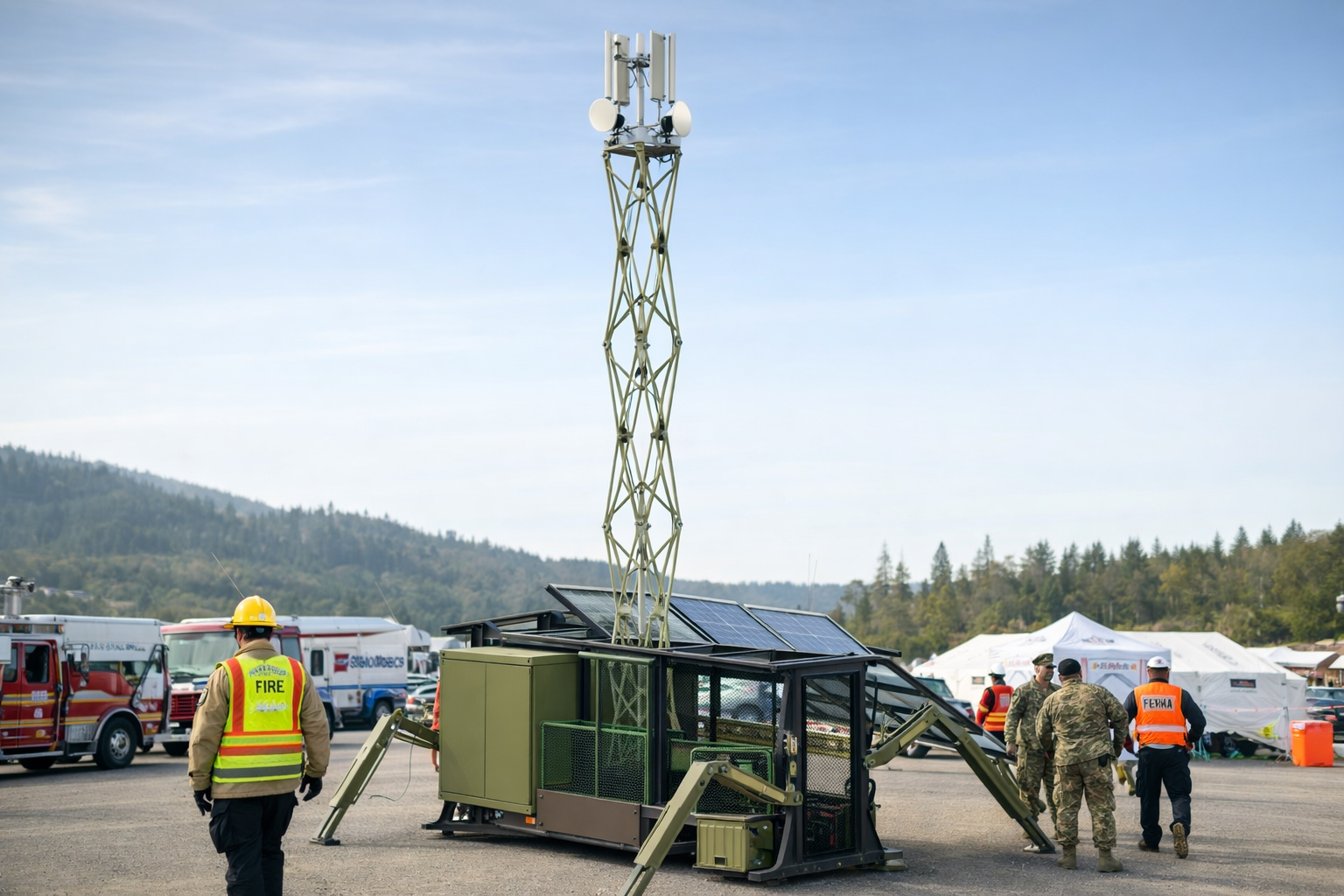
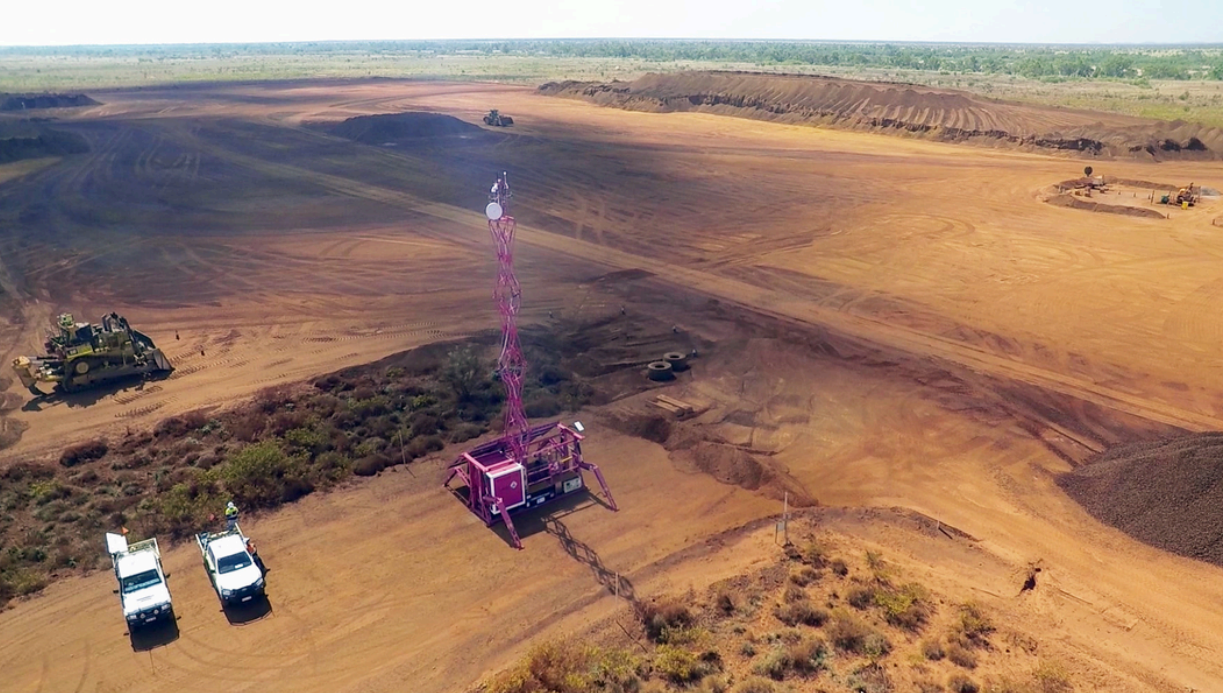
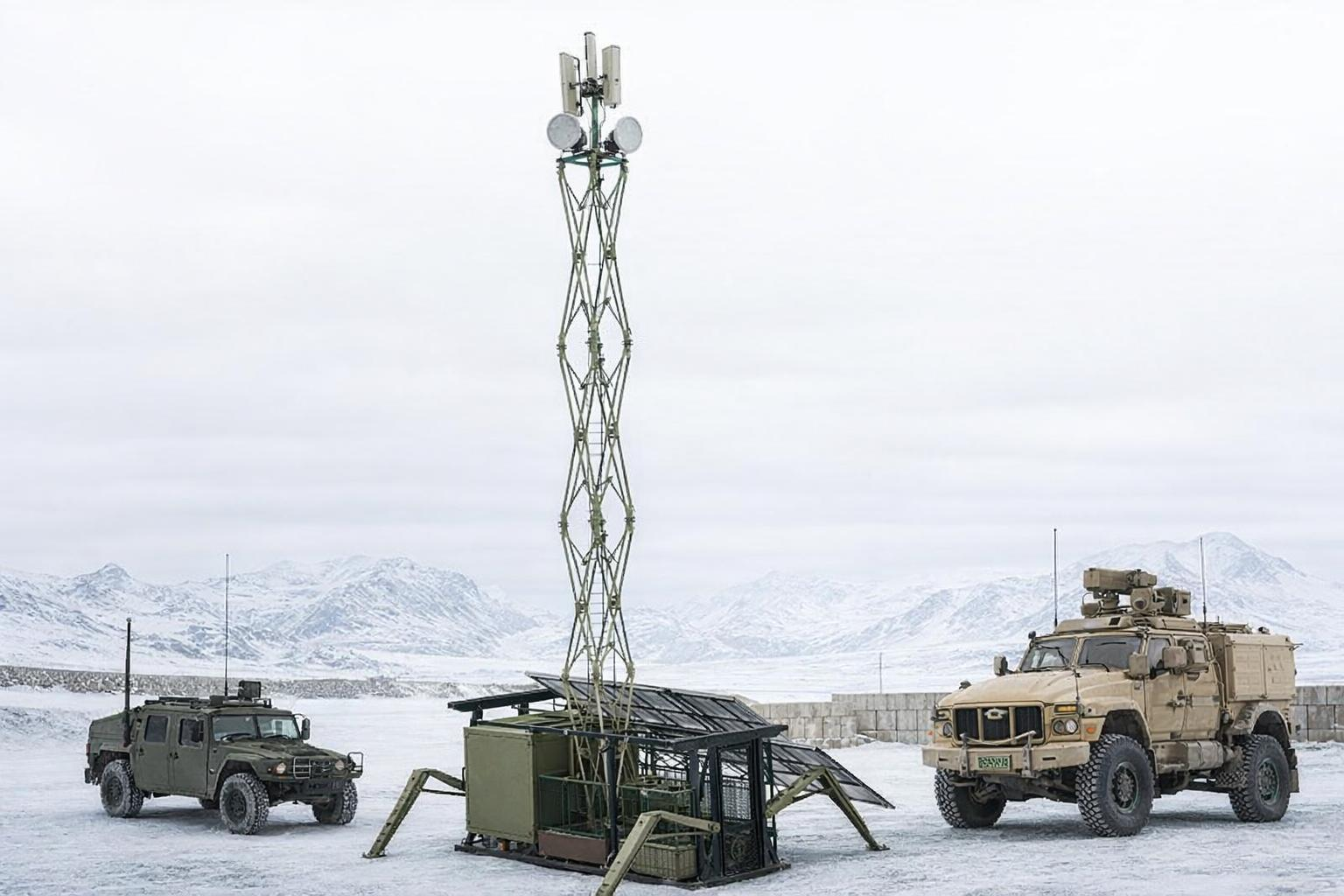
The Nexus platform changes all of that. Drop it by truck, helicopter, or cargo aircraft. In 30 minutes, four hydraulic legs stabilize, a solar array unfolds, and a mast rises up to 24 meters. No crew. No diesel. No waiting. CiTech (CSE:CTTT) (OTC:CITLF) built a system that deploys where fixed infrastructure cannot and arrives ready to work.
The Market Is Massive, and Still Running on Legacy Technology
Global telecom towers: $67.9 billion in 2025, growing to $165 billion by 2034.¹⁶ Defense communications: $56.4 billion in 2025, forecast to hit $145 billion by 2035.¹⁷ Remote towers alone: $472 million today, $2.3 billion by 2033.¹⁸ Yet most of this market still runs on concrete pads and crane setups. CiTech (CSE:CTTT) (OTC:CITLF) is offering something the entire industry has been missing.
Demand Is Already Here
The Ukrainian Ministry of Defence requested 50 Nexus units. The Babcock partnership, originally signed for Ukraine, has expanded to cover all of Europe and Southeast Asia.¹⁹ The first Nexus 20 arrives in the EU in April 2026 for region-wide demonstrations. Multi-billion dollar rare earth company Critical Metals Corp. (NASDAQ:CRML) has already paid a 30% deposit of $395,600 toward the purchase of a Nexus 20 platform for its Tanbreez rare earth project in Greenland.²⁰ Two Nexus 20 units completed final production in Australia. This company is no longer talking about potential. They are delivering.
From Drop-Zone to Fully Operational in 30 Minutes: The First-of-Its-Kind Platform That Other Defense Companies Cannot Replicate
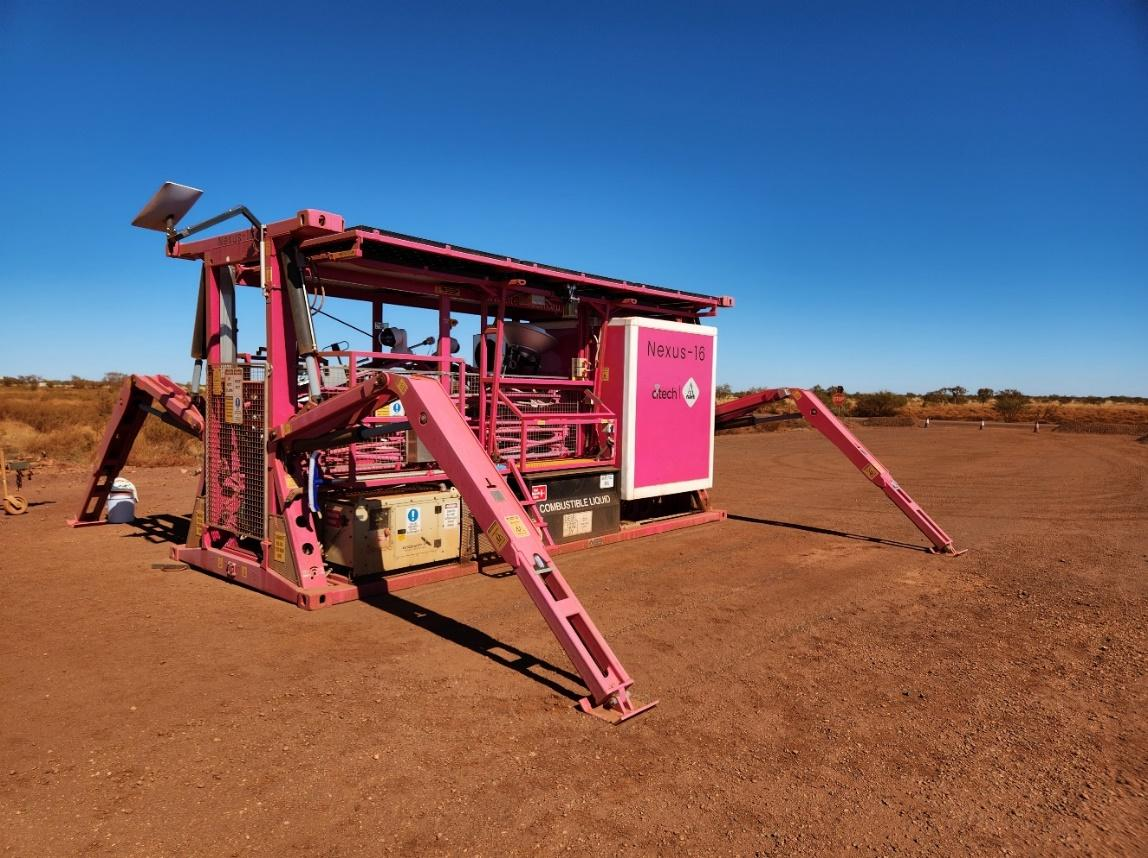
Most infrastructure takes weeks to deploy. CiTech (CSE:CTTT) (OTC:CITLF) does it in 30 minutes.
The Nexus platform is not just a communications tower. It is a self-contained, self-powering, fully autonomous field infrastructure system that shows up ready to work. Drop it off by truck, helicopter, or cargo aircraft. Four hydraulic legs lower and stabilize. A solar array unfolds. A rigid mast extends up to 24 meters. No cranes. No fuel trucks. No labor crews. Half an hour later, you have a fully operational communications and surveillance node.
The platform is payload agnostic. It can carry LTE radios from Ericsson or Nokia, radar systems, ISR sensors, drone launch platforms, counter-drone equipment, or thermal cameras. Each tower runs off-grid for weeks or months on solar power with battery storage.
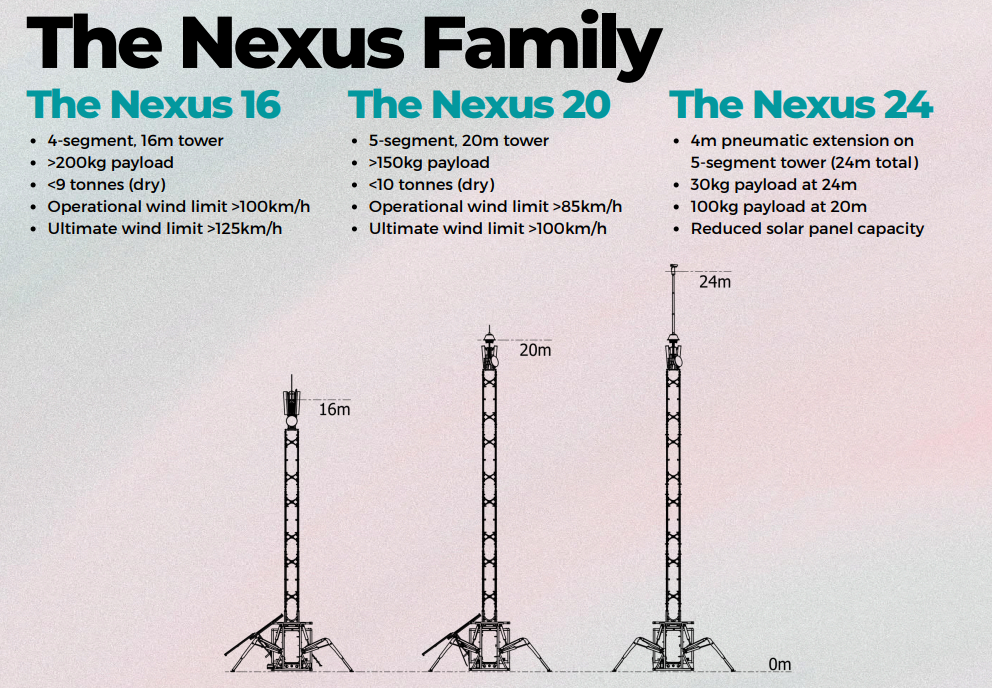
Critical Infrastructure Technologies Ltd. (CSE:CTTT) (OTC:CITLF) offers three Nexus variants:
- The Nexus 16 serves mining and commercial clients with a 200-kilogram payload capacity.
- The Nexus 20 is built for defense, carrying over 150 kilograms of mission systems. This is the model the Ukrainian Ministry of Defence requested, 50 units.
- The Nexus 24 extends to 24 meters for long-range surveillance and border security.
Already Proven in Extreme Conditions
CiTech (CSE:CTTT) (OTC:CITLF) does not need to guess whether Nexus works. Atlas Iron, one of Australia’s largest miners, deployed a Nexus unit at a remote site where autonomous haul trucks kept losing connection. That unit has been operational for 18 months. It survived a direct hit from a cyclone.²¹ That is not a lab test. That is real-world validation in one of the harshest environments on Earth.
A Revenue Model Built for Recurring Income
- €550,000 base / €725,000 mil-spec: outright sale
- €22,500 per month: 60-month lease generating €1.35M per unit over term
- ∼€1,750 per day: short-term rental for emergency/event deployments
Then add recurring revenue from software subscriptions, maintenance, and payload support. Gross margins exceed 50% on hardware alone. Software and services push that higher. Every unit CiTech (CSE:CTTT) (OTC:CITLF) deploys becomes a long-term revenue stream.
Swarmer Reported $309,920 in Total Revenue for All of 2025, Has One Customer, and Lost $8.5 Million. The Market Pushed It Past $680 Million. CiTech Has Multiple Customers, Real Hardware, and Sovereign Government Contracts, Yet Trades at $49 Million
Let us put the numbers on the table, because they tell a story the headlines completely ignored.
Swarmer (NASDAQ:SWMR) reported total revenue of $309,920 for fiscal year 2025. Not $309 million. Not $30 million. Three hundred and nine thousand dollars. That figure was also down 6% from the prior year. The company posted a net loss of $8.5 million in 2025, a dramatic worsening from the $2.1 million loss it recorded in 2024. And according to its own SEC filing, substantially all of its revenue over the last two years came from a single company: Smart Machinery Solutions, based in Ukraine. One customer. One country. A business built almost entirely on a single wartime relationship.
Swarmer does have a firm backlog of $16.3 million in orders expected over the next 12 to 24 months, and its technology has genuine merit, with over 100,000 combat missions logged and 42 armed forces using its platform. That is a real story. But the market did not price it as a $680 million company because of $309,920 in revenue. It priced it that way because of the narrative: AI, drones, Ukraine, and defense spending. When that narrative catches fire, fundamentals become secondary.²²
Now consider Critical Infrastructure Technologies Ltd. (CSE:CTTT) (OTC:CITLF) against that same lens.
The manufacturing acquisition alone brings AUD$7.4 million (US$4.9 million) in annual revenue and AUD$1.9 million in EBITDA from day one, from a profitable, ISO-certified, defense-accredited facility with a real customer base.
That is more than fifteen times Swarmer’s entire 2025 revenue, sitting inside a single acquisition the market has barely priced in. On top of that, CiTech (CSE:CTTT) (OTC:CITLF) has already received a $395,600 deposit from Critical Metals Corp. (NASDAQ:CRML) for its first Nexus 20 sale to Greenland, plus AUD$1.16 million in sovereign government grant funding from the Australian Department of Defence. A single Nexus 20 unit at the base sale price of €550,000 generates more revenue in one transaction than Swarmer reported in all of 2025.²³
The customer base is not a single company in a single country. It spans Australia, Ukraine, Greenland, and is expanding into Poland, Latvia, and across Europe and Southeast Asia through Babcock International. CiTech (CSE:CTTT) (OTC:CITLF) has a FTSE 100 defense prime as its distribution partner, Denmark’s largest defense technology company integrating radar into its platform, and a letter of intent with Poland’s sovereign defense manufacturing group. These are not one-customer relationships. This is a diversified, multi-continent commercial foundation.
Here is the number that should stop every investor cold.
Swarmer’s $680 million market cap divided by its $309,920 in 2025 revenue implies a price-to-sales multiple of roughly 2,194 times. Critical Infrastructure Technologies Ltd. (CSE:CTTT) (OTC:CITLF) at $49 million, with the manufacturing acquisition contributing US$4.9 million in annual revenue, implies a price-to-sales multiple of approximately 10 times. Not 2,194 times. Ten times.
That is not a small gap in how the market is valuing two defense-adjacent companies. That is a gap of more than 13 to 1 on market cap alone, and a price-to-sales ratio nearly 220 times wider, despite CiTech (CSE:CTTT) (OTC:CITLF) having more revenue, more customers, more countries, more physical assets, more government validation, and a more complete and harder-to-replicate product.
Swarmer proved the narrative works. The market will race to a $680 million valuation on defense drone technology before it stops to read the income statement. CiTech’s (CSE:CTTT) (OTC:CITLF) fundamentals are stronger, its story is more complete, and the market has not looked at it yet. Given what just happened with Swarmer in 48 hours, the odds that this gap closes look compelling.
A Partnership Roster That Reads Like a NATO Defense Industry Directory, and It Has Been Expanding Rapidly
Most small-cap defense companies spend years chasing one partnership. CiTech (CSE:CTTT) (OTC:CITLF) has been stacking them at a pace that defies its size.
Two Doors Into the US Federal Market
Getting a foreign defense product into the Pentagon’s supply chain is brutally hard. CiTech (CSE:CTTT) (OTC:CITLF) signed an NDA with Hui Huliau, a Native Hawaiian Organization with multiple SBA 8(a) certified subsidiaries, opening a fast-track procurement channel that bypasses the usual years-long approval process.²⁴ That is a direct lane into US defense, homeland security, and emergency management contracts, a lane most foreign companies never get.
Babcock International: A FTSE 100 Partner Across Two Continents
In September 2025, CiTech (CSE:CTTT) (OTC:CITLF) and Babcock International (LSE:BAB) signed an MOU to co-develop platforms for the Ukrainian Armed Forces. In December, the scope expanded: the MOU now covers all of Europe and Southeast Asia.²⁵ The first Nexus 20 arrives in the EU in April 2026 for region-wide demonstrations. Three-way NDAs with Nokia and Ericsson integrate full 4G/5G communications into the Nexus 20, making it a complete battlefield communications node, not just a tower.
Terma A/S: Denmark’s Largest Defense Tech Company (New, February 2026)
CiTech (CSE:CTTT) (OTC:CITLF) signed an MOU with Terma A/S, Denmark’s largest defense technology company specializing in radar systems, electronic warfare, and mission-critical software, to integrate Terma radar systems into the Nexus platform.²⁶ Planned demonstrations include DAIMEX BALTIC 2026 in Lithuania (May 2026), the International Drone Summit in Riga (May 2026), and the MSPO International Defence Industry Exhibition in Poland (September 2026). This is not aspirational. These are scheduled events on the NATO defense calendar.
- Cegielski-Poznań / PGZ: NATO’s Eastern Flank Manufacturing Hub (New, February 2026)
In February 2026, CiTech (CSE:CTTT) (OTC:CITLF) executed a Letter of Intent with H. Cegielski-Poznań S.A. (HCP), a subsidiary of Polska Grupa Zbrojeniowa (PGZ), Poland’s leading defense and industrial group. The LOI establishes HCP as a manufacturing and integration hub for Nexus 20 platforms across Central and Eastern Europe,²⁷ targeting the Polish Armed Forces and NATO’s Eastern Flank. CEO Brenton Scott is scheduled to visit HCP headquarters in Poznań, Poland in March 2026, with the first Nexus 20 prototype unit slated for delivery to Poland in May 2026 for proof-of-concept demonstrations.
Latvian Ministry of Defence: Sovereign Recognition and European Manufacturing Base (New, February 2026)
Critical Infrastructure Technologies Ltd. (CSE:CTTT) (OTC:CITLF) received a Dual-Use Innovation Certificate from the Latvian Ministry of Defence, enabling the company to apply for up to €3.0 million in financing from Latvia’s ALTUM state development finance institution to establish manufacturing operations in Liepāja.²⁸ Upon project completion, up to 30% of the loan may convert to a capital grant. Latvia is being established as CiTech’s European Headquarters, providing a NATO-integrated manufacturing base with a 4% corporate tax rate in the Liepāja Special Economic Zone.
The Full Partner Stack
Add in partnerships with DroneShield for counter-UAS, Draganfly (NASDAQ:DPRO) for NDAA-compliant drones,²⁹ Aqura Technologies (Telstra Purple) for private networks and edge compute, Aegis Critical Energy for advanced battery storage, and AIRmarket³⁰ for expanded distribution. Every capability gap has a partner filling it. This is not a company waiting for its first relationship. This is a company with a full ecosystem already operational, covering every major allied defense market.
Now step back and look at what CiTech (CSE:CTTT) (OTC:CITLF) has assembled: two US federal procurement pathways, a FTSE 100 defense prime across Europe and Southeast Asia, Nokia and Ericsson for telecom integration, Denmark’s largest defense company for radar integration, Poland’s sovereign defense manufacturing group for NATO Eastern Flank production, and the Latvian Ministry of Defence for European headquarters and manufacturing. At this market cap, that is not normal.
Press Releases
- Critical Infrastructure Technologies and Juno Industries Execute JV Agreement to Develop and Deploy Arctic-Focused Autonomous Nexus Platform
- Critical Infrastructure Technologies Signs Share Sale Agreement to Acquire Western Australian Engineering Business
- Critical Infrastructure Technologies United States Patent Application Granted
- Critical Infrastructure Technologies Ltd. Executes an Memorandum of Understand (MOU) with Terma A/S
- Critical Infrastructure Technologies Ltd. Receives a Dual-Use Innovation Certificate from the Latvian Ministry of Defence
From Design Shop to Sovereign Defense Manufacturer: The Acquisition That Transforms the Entire Business Model
Partnerships open doors. But owning your own production changes the economics entirely. Most hardware companies outsource manufacturing. They design the product, then hand it off to a contract manufacturer who controls the timeline, the margins, and the quality.
CiTech (CSE:CTTT) (OTC:CITLF) signed a binding term sheet to acquire 100% of a Western Australian precision manufacturing business valued at AUD$7.7 million (US$5.14M), with DISP (Defence Industry Security Program) accreditation already in place. This acquisition delivers:
- AUD$7.4M+ (US$4.9M) in annual revenue from day one
- AUD$1.9M+ (US$1.26M) in annual EBITDA
- ISO 9001, 14001, and 45001 certifications: quality, environment, safety
- State-of-the-art equipment: laser cutting, CNC folding, robotic welding, CAD/CAM
- DISP accreditation enabling classified Australian defense contract participation
Once this deal closes, Critical Infrastructure Technologies Ltd. (CSE:CTTT) (OTC:CITLF) will control the entire production chain for Nexus: design, fabrication, assembly, and deployment. No waiting on third-party suppliers. No margin compression from contract manufacturers. No bottlenecks when orders accelerate. To fund the acquisition, the company engaged Moneta Securities to raise up to AUD$10 million (US$6.68M).
The Catalyst Pipeline Is Stacking Fast, and Every Month Has Brought a New Milestone That Most Investors Haven’t Seen Yet
Since the original publication of this report in mid-January, CiTech (CSE:CTTT) (OTC:CITLF) has continued to execute at a pace that is remarkable for a company at this market cap. Here is what has happened in just the past 60 days:
February 27, 2026: Patent Filing Update
The company filed an updated patent application to strengthen IP protection around the Nexus autonomous deployment platform, broadening the defensibility of its core technology.
February 25, 2026: MOU with Terma A/S (Denmark’s Largest Defense Tech Company)
Terma brings world-class radar systems and a deep NATO customer base. The MOU establishes a framework to integrate Terma radar into the Nexus platform, with joint demonstrations planned at three major European defense exhibitions in 2026. CiTech (CSE:CTTT) (OTC:CITLF) is now walking the NATO defense exhibition circuit with one of Europe’s most respected defense technology firms.
February 23, 2026: Latvian Ministry of Defence Dual-Use Innovation Certificate
Formal sovereign recognition of the Nexus platform’s dual-use technology status. Unlocks access to €3.0 million in ALTUM state financing, with up to 30% potentially converting to a capital grant. Latvia will serve as CiTech’s EU headquarters, with a planned facility in the Liepāja Special Economic Zone.
February 18, 2026: LOI with H. Cegielski-Poznań / PGZ Group
HCP is part of Polska Grupa Zbrojeniowa (PGZ), Poland’s sovereign defense manufacturing group. The LOI establishes HCP as a Nexus 20 manufacturing and integration hub for Central and Eastern Europe, directly targeting the Polish Armed Forces and NATO’s Eastern Flank. Critical Infrastructure Technologies Ltd. (CSE:CTTT) (OTC:CITLF) is being integrated into Poland’s sovereign defense industrial base.
February 17, 2026: Financial Position Strengthened
$973,685 received from warrant exercises, plus a $395,600 deposit from Critical Metals Corp. (NASDAQ:CRML) for the first Nexus 20 sale to Greenland. Total new capital: over $1.37 million in a single announcement. CiTech (CSE:CTTT) (OTC:CITLF) now has the financial runway to complete five Nexus units currently in production.
January 29, 2026: Sale to Critical Metals Corp. in Greenland Confirmed
Multi-billion dollar rare earth company Critical Metals Corp. (NASDAQ:CRML) is deploying a fully autonomous Nexus 20 communications tower plus integrated drone system at its Tanbreez rare earth project in Greenland. The unit is engineered for Arctic conditions, delivering always-on communications, 360-degree site surveillance, and remotely operated drone imaging. This is the kind of real-world, harsh-environment deployment that proves the Nexus platform is not a demo product.
January 26, 2026: MOU with AIRmarket
An additional distribution and commercial partnership, expanding CiTech’s (CSE:CTTT) (OTC:CITLF) market reach further.
Where CiTech Sits in the Landscape, and Why the Swarmer IPO Makes the Valuation Gap Impossible to Ignore
Every company in the table below trades at a significant premium to CiTech (CSE:CTTT) (OTC:CITLF). And critically, none of them offer a fully autonomous, self-deploying, self-powering platform that can be operational in 30 minutes. Swarmer, now the primary comparable after its explosive debut, has no physical hardware, no deployed infrastructure, and a fraction of CiTech’s real-world validation. Yet it trades at nearly 8x CiTech’s market cap.
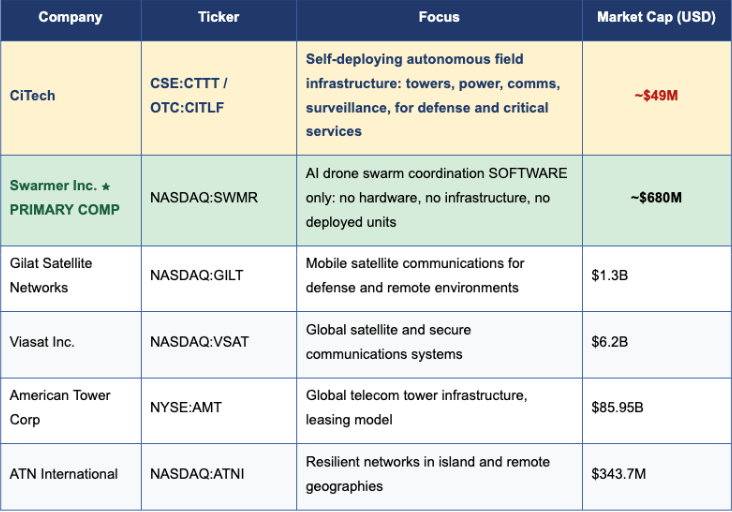
*Market caps: Swarmer from StockTitan (March 18, 2026); others from Yahoo Finance (January 16, 2026).
Gilat proved governments pay for connectivity at the edge. American Tower proved infrastructure ownership scales to $85 billion. Viasat proved defense communications is a multi-billion dollar market. Swarmer just proved the market will race to price drone-defense technology at massive multiples the moment it sees the story.
Critical Infrastructure Technologies Ltd. (CSE:CTTT) (OTC:CITLF) is combining all of those insights into one platform: the ownership model, the defense communications need, the drone-era infrastructure layer. And it is trading at $49 million. A fraction of the valuation of a pure-software drone company with no physical assets. This is not a subtle gap. This is a canyon.
10 Reasons
to Put CiTech on Your Radar Right Now, Before the Market Catches Up
1
Swarmer’s 1,100% IPO Exposed the Most Extreme Valuation Disconnect in Defense Tech, and CiTech Is on the Wrong Side of It: Swarmer reported $309,920 in total 2025 revenue, lost $8.5 million, and has one customer in Ukraine. The market pushed it past $680 million within days of its IPO. CiTech (CSE:CTTT) (OTC:CITLF) has more revenue, more customers, more countries, real hardware in the field, and sovereign government backing. It trades at $49 million. One of these is priced rationally. The other is an opportunity.
2
Production Is Live, Not Promised: The first two Nexus 20 units completed final fit-out at the company’s South Fremantle facility. The first sale to Greenland has been confirmed with a $395,600 deposit received. Five Nexus units are now in active production.
3
Sovereign Government Backing, Now on Two Continents: The Australian Department of Defence awarded CiTech (CSE:CTTT) (OTC:CITLF) a AUD$1.16M grant to fund Nexus production. The Latvian Ministry of Defence issued a formal Dual-Use Innovation Certificate, unlocking access to up to €3.0M in ALTUM state financing.
4
NATO’s Eastern Flank Is Now an Active Manufacturing Target: The LOI with HCP/PGZ, Poland’s sovereign defense manufacturing group, positions CiTech (CSE:CTTT) (OTC:CITLF) as a Nexus production and integration partner for Central and Eastern European defense clients. The first prototype goes to Poznań, Poland in May 2026.
5
Denmark’s Top Defense Company Is Now a Technology Partner: The Terma MOU brings radar integration and a presence at three major 2026 NATO defense exhibitions, including MSPO and DAIMEX BALTIC. Critical Infrastructure Technologies Ltd. (CSE:CTTT) (OTC:CITLF) is now walking the NATO circuit with credentialed partners.
6
A FTSE 100 Partner Already Moving Product: Babcock International is taking Nexus across Europe and Southeast Asia. The first EU demonstration unit arrives in April 2026. Ukraine has already requested 50 units.
7
Blue-Chip Technology Stack: Nokia, Ericsson, DroneShield, Draganfly, Aqura (Telstra Purple), Terma, Aegis Critical Energy. CiTech (CSE:CTTT) (OTC:CITLF) has assembled best-in-class partners for 4G/5G comms, counter-UAS, NDAA-compliant drones, private networks, battery storage, and radar. Every capability gap has a partner.
8
Vertical Integration and Defense Accreditation:The manufacturing acquisition brings AUD$7.4M+ in revenue, AUD$1.9M+ in EBITDA, and DISP defense accreditation on day one. This transforms CiTech (CSE:CTTT) (OTC:CITLF) from a hardware developer into a vertically integrated sovereign defense manufacturer.
9
A Revenue Model Built for Recurring Income: Outright sale (€550K–€725K), lease (€22,500/month on 60-month terms), short-term rental (~€1,750/day), plus software subscriptions and maintenance. Every unit deployed becomes a long-term revenue relationship. Gross margins exceed 50% on hardware alone.
10
Trading at a Fraction of Every Comparable Peer: Swarmer at ~$680M. Gilat at $1.3B. Viasat at $6.2B. American Tower at $85B. CiTech (CSE:CTTT) (OTC:CITLF) at $49M, with signed government contracts, hardware in the field, production underway, a manufacturing acquisition, and partnerships spanning five countries and three continents.
The market has not caught up yet. Given everything above, and given how fast it caught up with Swarmer, that gap looks like an opportunity, not a warning sign.
The Bottom Line
Swarmer just handed the market a live demonstration that investors will reprice defense drone technology to extraordinary valuations before they ever look at the income statement. A company with $309,920 in annual revenue and one customer surged past $680 million in a matter of days. The physical infrastructure behind drone operations, including the towers, the power, the autonomous deployment, and the surveillance nodes, is fundamentally more valuable than the software alone. And CiTech (CSE:CTTT) (OTC:CITLF) is the only public company at the small-cap level building it at scale, with real deployments, real partnerships, and real sovereign government backing.
Most small-cap defense stories ask you to imagine what could happen. CiTech (CSE:CTTT) (OTC:CITLF) is showing you what is already happening. Production is live. Partners are signed across five countries. Channels are open. Cash is coming in from real customers. And the stock is still priced like none of it exists.
That gap does not usually last.
The Team That Has Done This Before: Operators, Not Dreamers
Defense contracts do not go to companies with good ideas. They go to companies that execute. CiTech (CSE:CTTT) (OTC:CITLF) is led by operators who have spent decades building, selling, and deploying complex systems in demanding environments.
The Window Is Open, But Swarmer Just Showed You How Fast It Can Close
Defense spending is surging. The White House just called for a US$1.5 trillion military budget. NATO allies are racing to modernize. The Asia-Pacific is arming up. Drone technology just minted a 1,100% IPO overnight. And autonomous infrastructure has moved from “nice to have” to “mission critical.”
Critical Infrastructure Technologies Ltd. (CSE:CTTT) (OTC:CITLF) is sitting at the center of all of it.
Production is live. Five Nexus units are being built right now. A manufacturing acquisition that adds immediate revenue and defense accreditation is in its final stages. Europe-wide demonstrations with a FTSE 100 partner begin in April. A Latvian manufacturing hub is being established. NATO exhibition appearances are booked from May through September 2026. Poland’s sovereign defense group is preparing to receive the first prototype.
And the stock is still trading at US$49 million. That is less than 8% of what Swarmer reached with $309,920 in annual revenue, one customer, and no physical product.
Swarmer showed how fast the market reprices these stories when it finally pays attention. CiTech’s (CSE:CTTT) (OTC:CITLF) story is more complete, more validated, and more difficult to replicate. The window is open right now. Before the next Terma demonstration goes viral. Before the Babcock EU tour makes the mainstream feed. Before the NATO Eastern Flank manufacturing announcement triggers the next headline.
The production is underway. The partners are signed. The clock is running.
If you want to track this one in real time, get on the list now.
Subscribe to the Trading Whisperer newsletter to receive the latest corporate presentation the moment it drops, plus the key updates that tend to move a story like this before they hit the mainstream feed.
Get the newest presentation and updates through Trading Whisperer today.