In the 1920s, a young miner went underground at a place called Premier, a few kilometers outside the town of Stewart in northern British Columbia.
Premier was a famous mine. Over its life the complex produced about 2.1 million ounces of gold and 42 million ounces of silver.1 Generations of Stewart families made their living there.
That miner’s grandson grew up in Stewart, started his career working in the Premier mill in 1991 and later became a geologist at a deposit called Red Mountain, just down the valley.
His name is Robert McLeod. At the end of 2025, he took over as President and CEO of the company that owns both of those deposits, after it had come close to collapse.2
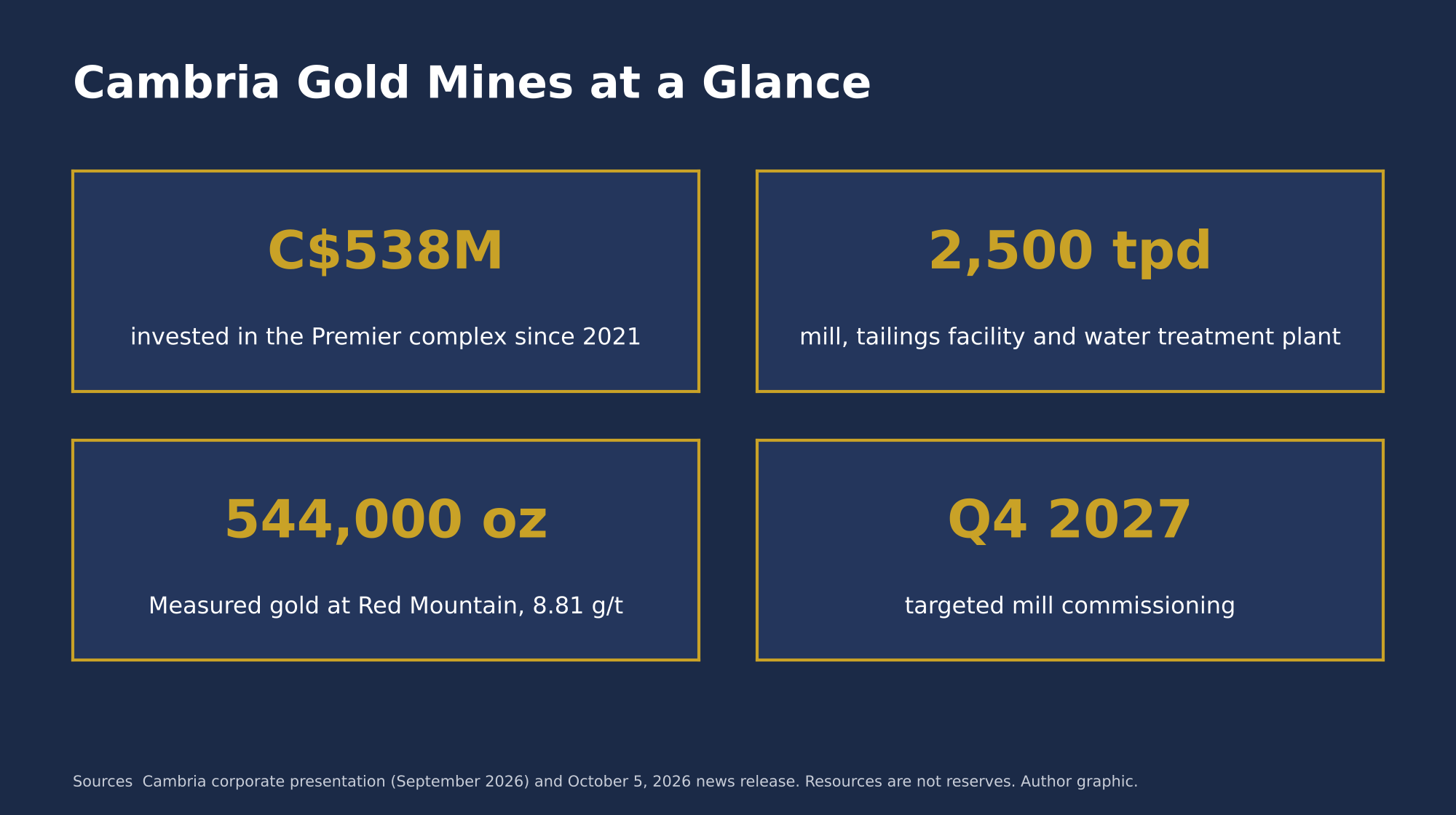
The previous owner had done something remarkable and something disastrous at the same time. It spent about C$538 million since 2021 building a brand new 2,500 tonne per day mill, a tailings facility, a water treatment plant and about 6,300 meters of underground development.3
Then, it ran out of road. Mining difficulties in 2024 led to a shutdown at Premier, the company was forced into a restructuring and its shares were moved to the NEX board before a rescue financing put it back on its feet.4
Today, that mill is still standing, waiting for a restart. And on October 15, 2026, the entire company that owns it was valued at about C$298 million,5 roughly 40% less than what was spent on the complex in the last five years alone.6
Meet the Company Restarting Premier
That company is Cambria Gold Mines Inc. (TSXV:CAMB) (OTCQX:CAMVF).
It used to be called Ascot Resources. After the rescue, the new team renamed it Cambria, after the spectacular icefield next to Red Mountain, and set out a very different plan for the business.7
Cambria is targeting commissioning of the Premier mill in the fourth quarter of 2027, with production ramping up through 2028.8 Management’s stated goal is a “high-grade, hub and spoke gold operation that blends ore from several deposits through that one existing mill.”9
If that sounds like a big claim for Cambria at its current size, consider what the previous owners already paid for.
The mill is built. The tailings facility is built. The power line is built, because the Premier Gold Complex sits on British Columbia’s hydro grid, and has road access off Highway 37A.10
Cambria Gold Mines Inc. (TSXV:CAMB) (OTCQX:CAMVF) also reports about C$430 million in tax pools from all that spending, which could shelter future income once the mine is running.11
In other words, the hard and expensive part of building a gold mine has largely been done. What is left is the part that went wrong.
There is also plenty of gold to feed that mill. At Premier, Cambria Gold Mines Inc. (TSXV:CAMB) (OTCQX:CAMVF) reports Indicated resources of about 1.066 million ounces at 8.01 g/t gold plus about 1.18 million Inferred ounces at 7.25 g/t gold.12
Add Red Mountain, and the two projects hold more than 3 million ounces of gold resources across all categories, along with millions of ounces of silver.13
Resources are not reserves, and the updated feasibility study Cambria Gold Mines Inc. (TSXV:CAMB) (OTCQX:CAMVF) is preparing will restate them, but the scale is real.
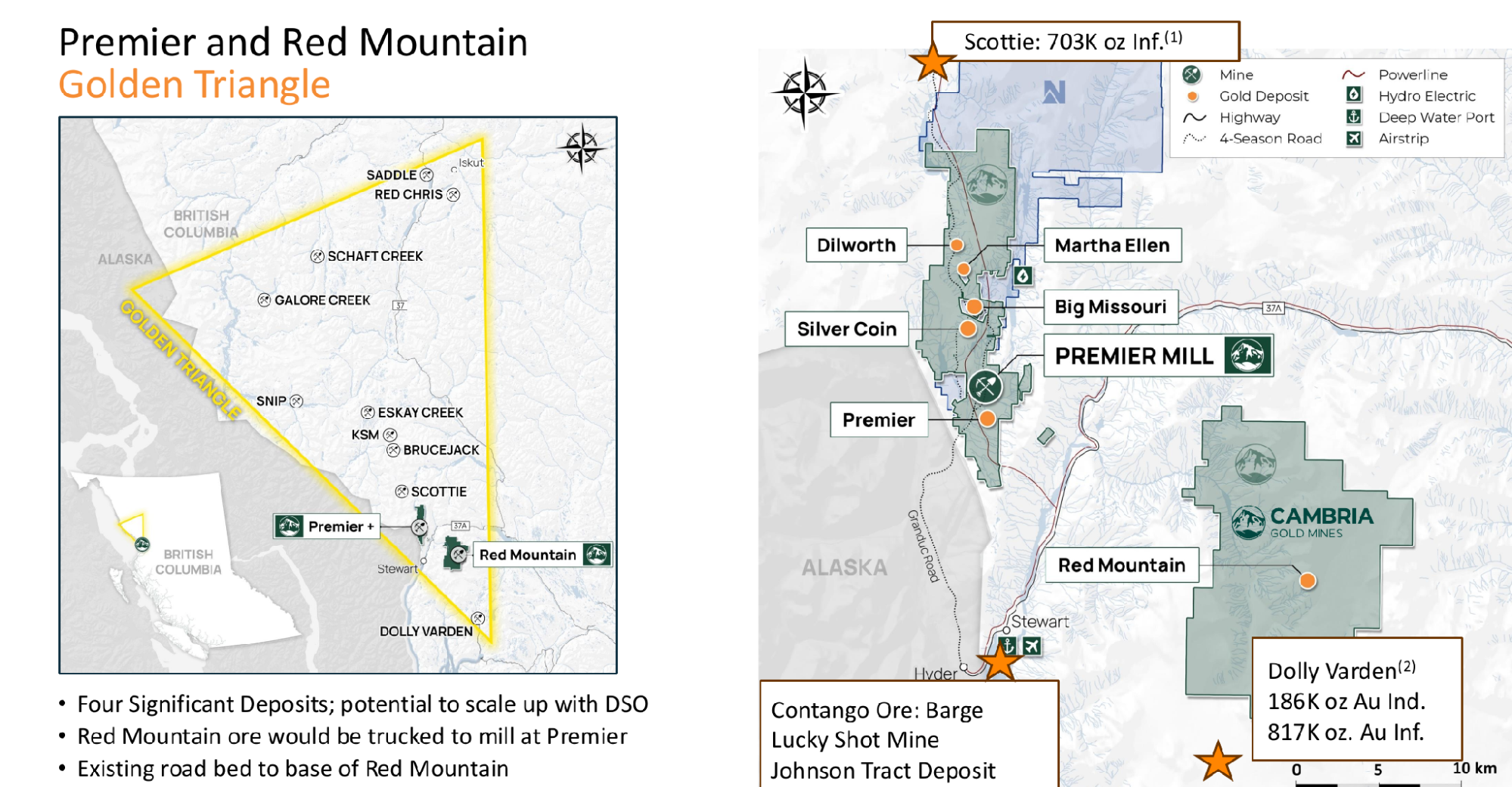
Location matters too. Premier sits in the Golden Triangle, one of the most prolific mining districts in Canada, and the Cambria Gold Mines Inc. (TSXV:CAMB) (OTCQX:CAMVF) presentation map shows other deposits nearby, including Scottie Resources and Dolly Varden.14
Cambria Gold describes its four significant deposits as having the potential to scale up over time. Owning a built mill in the district could make the company a natural hub for the region as more projects advance.
What Went Wrong the First Time
Cambria’s own presentation lists the mistakes plainly. The mill Cambria inherited was the same size as the 1990s open pit operation and hard to feed, Cambria Gold Mines Inc. (TSXV:CAMB) (OTCQX:CAMVF) says underground development started far too late and none of the deposits had been drilled tightly enough to support Proven Reserves.15
Leases and upkeep costs piled up. Most surprising, the previous owner did no work on Red Mountain, its highest grade deposit, after acquiring it in 2019.
At Cambria, the new team is attacking every one of those problems directly. Infill drilling at Premier is now being done on 12.5 meter spacing so the company can locate the gold with far more confidence before it mines it.16 Earlier surface drilling at roughly 25 meter spacing was too wide to model the zones accurately, which the company considers a likely contributor to the past difficulties.17
Cambria has been open about the water challenge as well. The water treatment plant at Premier struggled with zinc discharge compliance after it was built in 2024, so Cambria Gold Mines Inc. (TSXV:CAMB) (OTCQX:CAMVF) took over operations with its own staff, brought in consultants and upgraded equipment.18 Results improved over the two months before the October update.19
The geology itself has been rebuilt. The old 2021 model was built as grade shells, while Cambria’s new model factors in the quartz and sulfide veins, the breccias and the faults that cut through them.20
That is the kind of unglamorous work that separates a mine that runs from one that stumbles. It is also why the drilling results Cambria Gold Mines Inc. (TSXV:CAMB) (OTCQX:CAMVF) has reported this year have been worth paying attention to.
Press Releases
- Cambria Gold Mines Intersects 98.56 g/t Gold over 8.2 Metres at the Silver Coin Deposit, Premier Gold Project
- Cambria Gold Mines Announces Development and Construction Update at Red Mountain and Premier Gold Projects, Additions to Engineering Team and Warrants Exercised To-date
- Cambria Gold Mines Announces 166.2 g/t Au and 3,383 g/t Ag over 3.1 Meters at Premier and Expanded Drilling Program
- Cambria Gold Mines to Participate in the Gentile Mining Investor Forum in London
The Drill Results Are Backing Up the Plan
In April, Cambria Gold Mines Inc. (TSXV:CAMB) (OTCQX:CAMVF) reported that a hole into the 602 Zone at Premier returned 17.95 g/t gold over 22 meters, including 552 g/t gold over half a meter, with visible gold in the core.21
In June, Cambria Gold reported that underground infill holes at the Prew Zone returned 19.82 g/t gold over 5.0 meters and 483.0 g/t over 1.0 meter.22 July added 24.36 g/t gold over 6.3 meters and 13.17 g/t over 10.6 meters from the same zone.23
Then came September. Cambria Gold Mines Inc. (TSXV:CAMB) (OTCQX:CAMVF) reported 166.22 g/t gold and 3,383 g/t silver over 3.1 meters at Premier, including 467 g/t gold and 9,510 g/t silver over 1.1 meters.24
On the back of those results, Cambria expanded its infill program to 42,000 meters.26 Drilling has also moved to Silver Coin and Big Missouri, where earlier holes returned up to 20.75 g/t gold over 15.9 meters.27
Those two deposits matter for the early years. Cambria Gold Mines Inc. (TSXV:CAMB) (OTCQX:CAMVF) is modeling Big Missouri and Silver Coin as bulk mineable underground zones with some shallow open pit potential, and plans to blend that tonnage with high grade ore from Premier while Red Mountain is developed.
Over the long run, Cambria is targeting about 1,500 tonnes a day from Red Mountain and 500 from Premier, for 2,000 tonnes a day at high grade.28 That design keeps the mill fed with richer ore than the previous plan, which is the heart of the turnaround.
Individual intercepts are not average grades, and the company reports them as down hole lengths. But together they support the high grade continuity the new plan depends on.
Red Mountain: The Gold Deposit the Last Owner Ignored
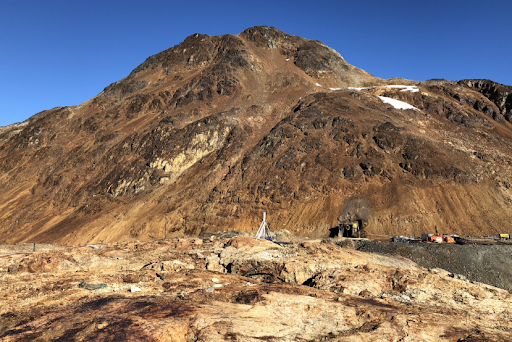
If Premier is the engine room for Cambria Gold Mines Inc. (TSXV:CAMB) (OTCQX:CAMVF), Red Mountain is the fuel. Cambria calls it the key to a successful operation, and the numbers quickly explain why the team feels that way.
Red Mountain hosts 544,000 ounces of gold in the Measured category at 8.81 g/t, part of a Measured and Indicated resource of about 783,000 ounces at 7.63 g/t.29 For Cambria, that matters because Measured is the highest confidence category a resource can carry.
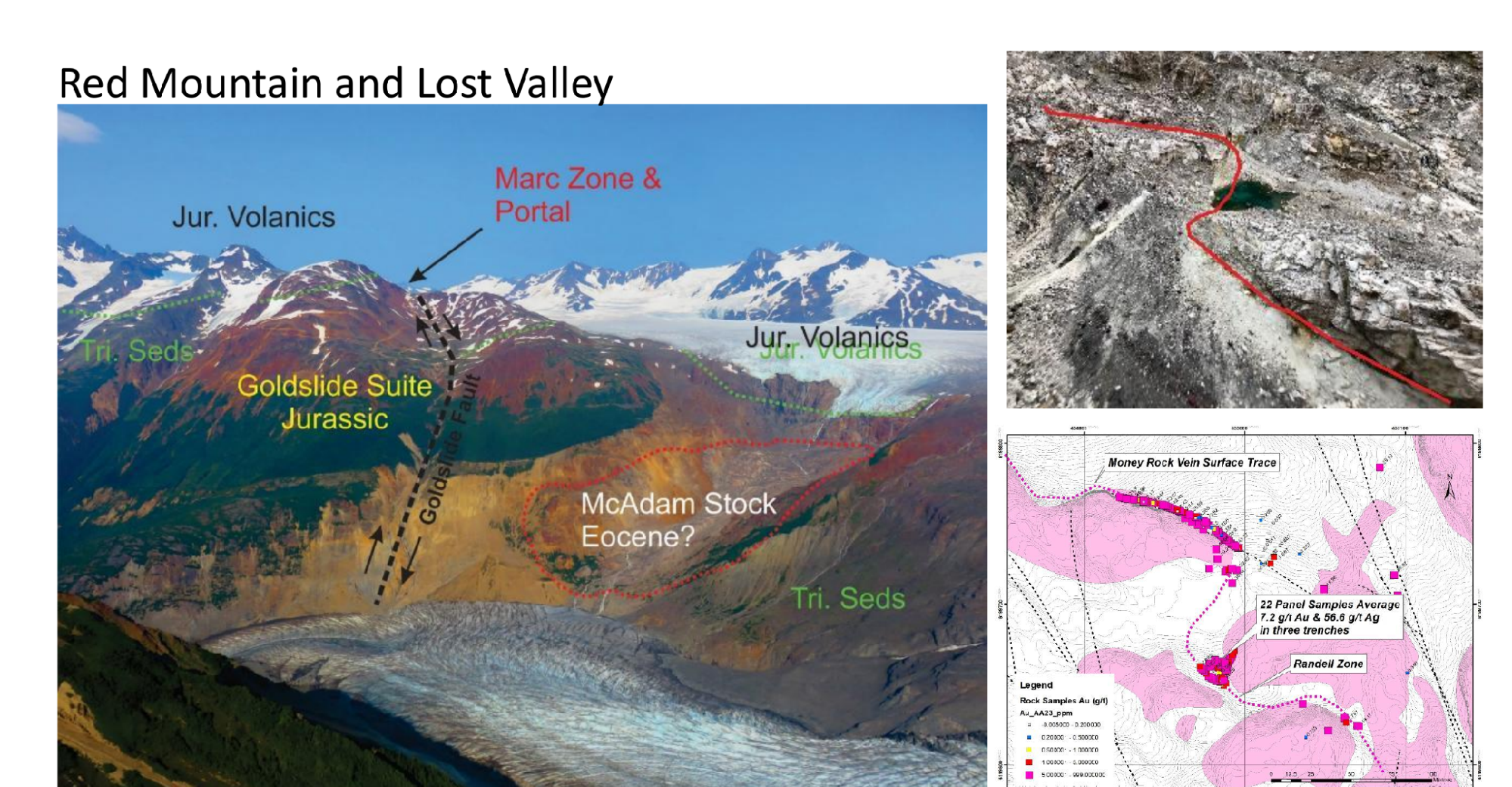
The deposit already has production size underground access within 200 meters of surface, and high grade zones reach up to 25 meters in true width at the Marc Zone. Average mineralization thickness is about 15 meters, and only about 1,600 meters of development is needed for the first year of stoping.
The gold occurs, Cambria Gold Mines Inc. (TSXV:CAMB) (OTCQX:CAMVF) says, as free gold right next to coarse pyrite grains, and the mineralized zones are surrounded by a broad, gold rich halo, with external dilution averaging about 2.1 g/t gold according to the company presentation.30 In plain and practical terms, even the waste rock that gets mixed in when Cambria mines still carries some gold.
Cambria Gold Mines Inc. (TSXV:CAMB) (OTCQX:CAMVF) says no additional drilling is required at Red Mountain until road access is in place, and the resource is open for expansion in multiple directions.31
The man running Cambria Gold Mines Inc. (TSXV:CAMB) (OTCQX:CAMVF) knows this rock personally. He was a junior geologist at Red Mountain for Lac Minerals in the early 1990s, long before Cambria existed, and he later led IDM Mining, which took the project through feasibility and its EA and EIS approvals before selling to Ascot in 2019.
The plan is to mine about 2,000 tonnes a day at Red Mountain for eight or nine months of the year, avoiding the deepest winter snow,33 and Cambria would truck the ore about 50 kilometers through Stewart and Hyder to the Premier mill.34
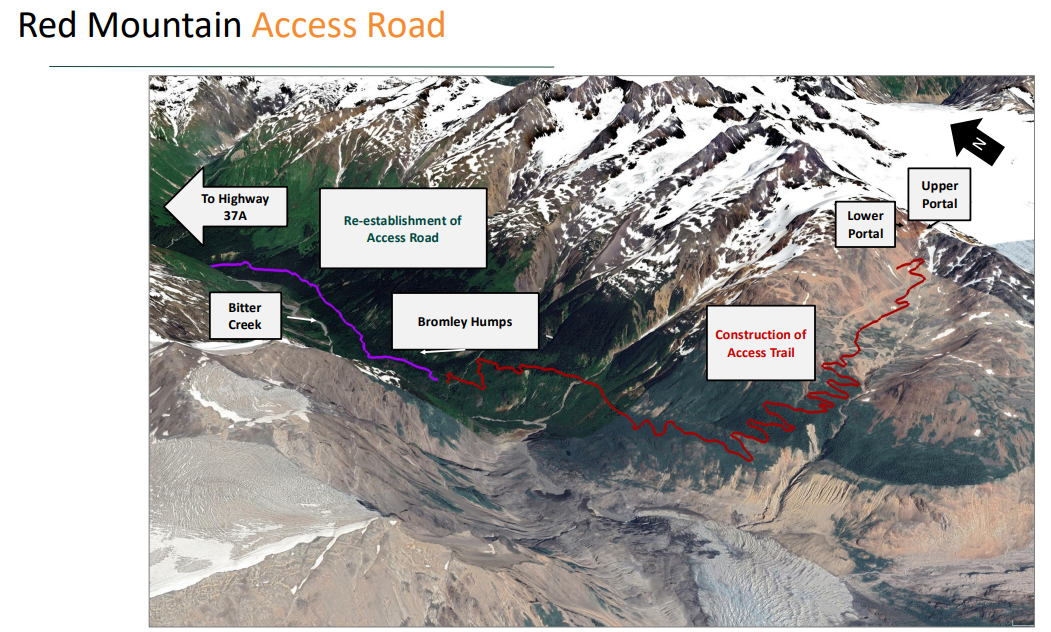
Getting there requires a road, and that work is under way now. Construction on the roughly 23 kilometer access road began in June, rebuilding a roadbed that dates back to 1910.35
Cambria Gold Mines Inc. (TSXV:CAMB) (OTCQX:CAMVF) is building it with partners. Red Mountain and Premier sit on Nisga’a Nation Treaty Lands, Nisga’a Growth Corp. is doing environmental monitoring on the road and fisheries offsets aim to improve salmon spawning habitat in the Bear River Valley.36
Over time, Cambria Gold Mines Inc. (TSXV:CAMB) (OTCQX:CAMVF) is studying an aerial tramline or rope conveyor from Red Mountain to the Bitter Creek valley, after the road.37 It is the kind of long term thinking you would expect from a team planning for many years of operation.
The final permit needed to build the road, a Fisheries Act Authorization, arrived on September 21. Cambria is aiming to reach the Bromley Humps area, about 12 kilometers from the highway, by the end of 2026, with the alpine section planned for the 2027 season.38
The Path to the First Gold Pour
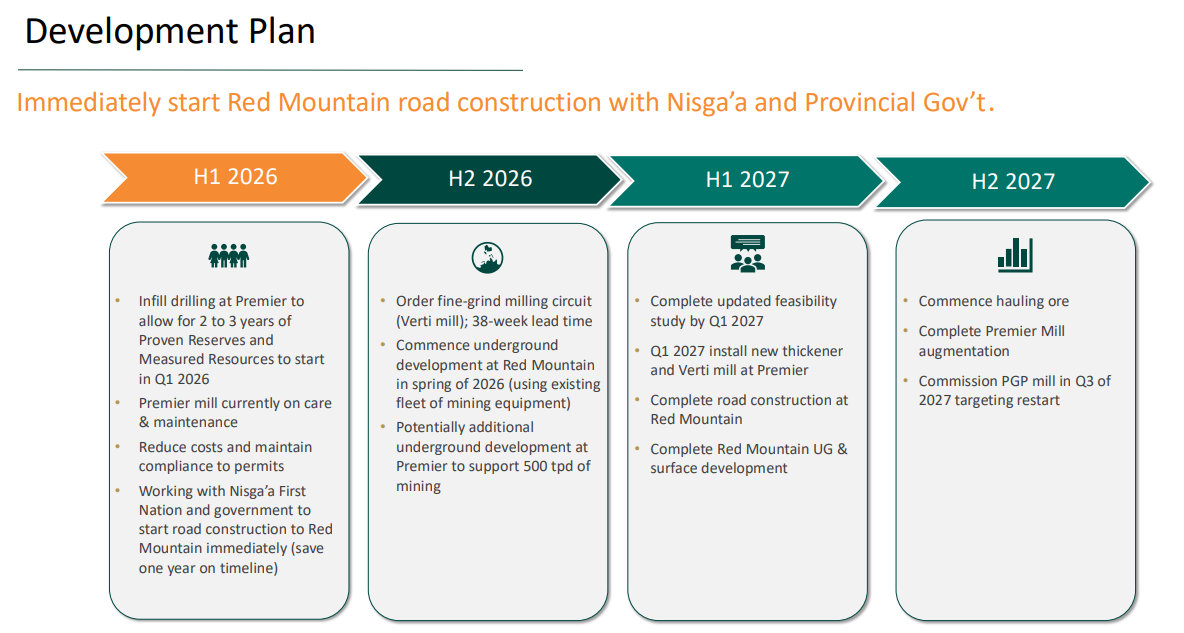
Cambria Gold Mines Inc. (TSXV:CAMB) (OTCQX:CAMVF) has laid out its timeline in public. Underground upgrades at the Premier Northern Lights deposit are due by the end of 2026, Silver Coin development is planned for spring 2027 and all of the mill upgrades are slated for completion during 2027.39
The updated feasibility study Cambria has commissioned, with SLR Advisors as lead author, covers both of the projects and is targeted for the first half of 2027. The company says no additional infill drilling is needed at Red Mountain.40
The mill upgrades are specific and modest compared with building from scratch. Cambria plans a new primary jaw crusher, converting an unused clarifier into a pre-leach thickener and adding a fine grinding mill and a second detox tank.
Cambria Gold Mines Inc. (TSXV:CAMB) (OTCQX:CAMVF) has also bought and commissioned its own underground equipment fleet and hired an entirely new engineering team of professionals, including an experienced underground manager with Golden Triangle experience at the Brucejack Mine.
Why a Restart Can Beat a Build
To see why an existing mill matters so much for Cambria Gold Mines Inc. (TSXV:CAMB) (OTCQX:CAMVF), look at what new mines cost in today’s market. Kinross, for example, is spending hundreds of millions of dollars to restart a mill and develop an underground mine in Washington State.41
Building takes time too. Artemis needed about 22 months to build Blackwater,42 and Osisko is targeting first gold at Cariboo in early 2029 after its decision in September 2026.43
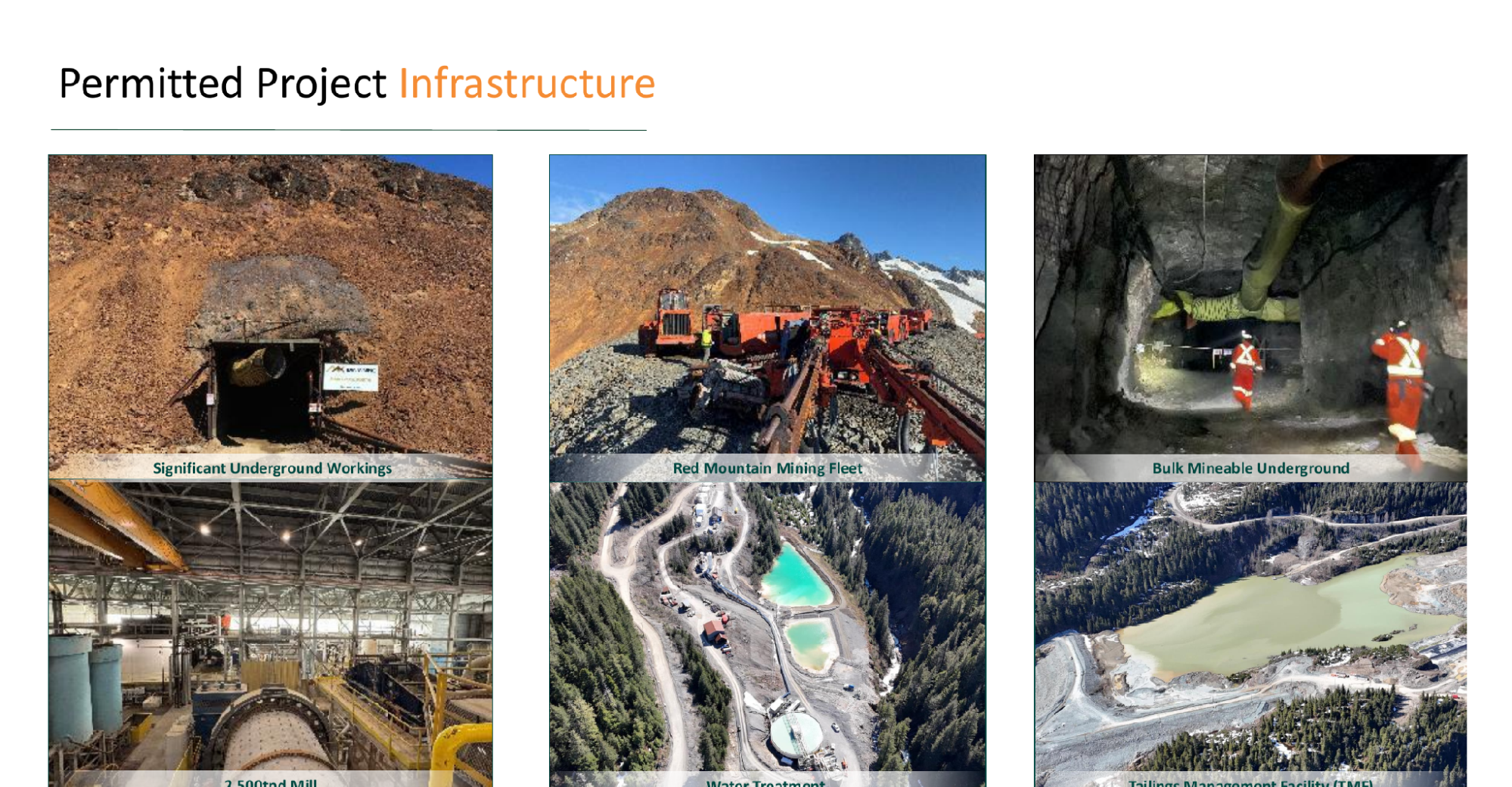
Cambria Gold Mines Inc. (TSXV:CAMB) (OTCQX:CAMVF) is starting from a very different place. The mill is standing, the tailings facility and water treatment plant are in place and kilometers of underground workings already exist.44
That is why the timeline Cambria has published is measured in quarters. The work that remains, from mill modifications to underground development and the Red Mountain road, is being done in parallel and targets commissioning in Q4 2027.
Restarts are not risk free, as the previous owner proved. But a restart led by people who understand what went wrong, using infrastructure that is already paid for, is a very different proposition from a greenfield build.
Why the Market May Be Looking at This the Wrong Way
Here is the pattern that matters for Cambria, one that has played out again and again in Canadian gold mining.
A developer like Cambria Gold Mines Inc. (TSXV:CAMB) (OTCQX:CAMVF) is valued as a risky project while it builds, and then valued as a producer once the gold starts flowing.
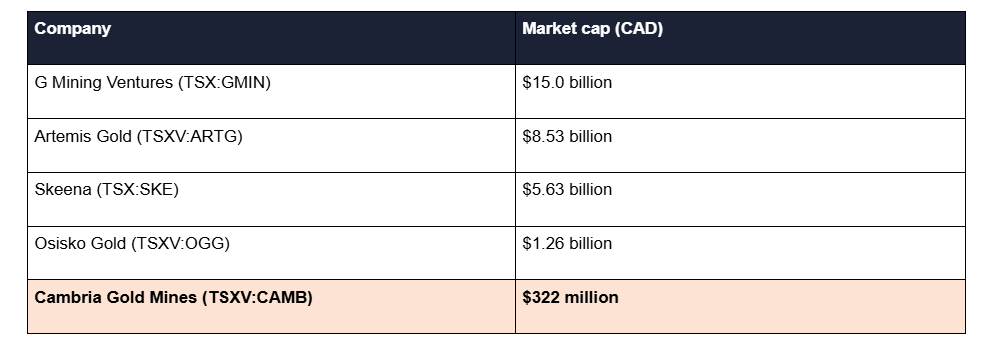
At the end of 2022, Artemis Gold was valued at about C$848 million while it was building its Blackwater mine in central British Columbia.45 Artemis declared commercial production in May 202546 and by October 15, 2026 the company was worth about C$9.22 billion.
Skeena, which is restarting the past-producing Eskay Creek mine right in the Golden Triangle, was valued at about C$546 million at the end of 2022.47 With first production targeted for 2027,48 it was worth about C$5.67 billion on October 15, 2026.
G Mining Ventures tells the same story. It was valued at about C$309 million at the end of 2022,49 and is now worth about C$13.64 billion (October 15, 2026). The company built its Tocantinzinho mine in Brazil and declared commercial production in September 2024,50 the step Cambria Gold Mines Inc. (TSXV:CAMB) (OTCQX:CAMVF) is now working toward.
Artemis and Skeena show where a successful developer can go, and Osisko Gold, which is building the Cariboo Gold project at Barkerville, is a fellow British Columbia developer that the company could be measured against.
Osisko made its final investment decision on Cariboo in September and is targeting first gold in early 2029.51 Cambria Gold Mines Inc. (TSXV:CAMB) (OTCQX:CAMVF) is targeting mill commissioning more than a year earlier, in the fourth quarter of 2027, with a mill that is already standing.52
None of this guarantees that Cambria will follow the same path. These companies differ in size, reserves and stage. But it shows what the market has paid for developers that reach production.
The US Copper Deposit: A Volcano Put on Hold for 30 Years
If the gold restart were the whole story, Cambria Gold Mines Inc. (TSXV:CAMB) (OTCQX:CAMVF) would already be worth a close look. But there is a second asset, and McLeod has called it found money in interviews.
It is called Mt. Margaret, a copper, gold and molybdenum porphyry deposit about 22 kilometers southwest of Randle, Washington.53
Duval Mining discovered it in the 1970s and drilled 105 holes by 1980. Then, in 1980, Mt. St. Helens erupted.54 According to Cambria Gold Mines Inc. (TSXV:CAMB) (OTCQX:CAMVF), roads and bridges were washed out, more than a foot of ash fell in places and work on the project stopped.55
Duval had produced a historical estimate of 577 million tonnes grading 0.36% copper and 0.24 g/t gold.56
Nobody drilled the deposit again until 2010, when Ascot put in 11 holes that confirmed the historic mineralization and doubled its known depth extent.57 One of those holes ran 499.9 meters at 0.34% copper, and another ran 496.0 meters at 0.46% copper and 0.23 g/t gold.58
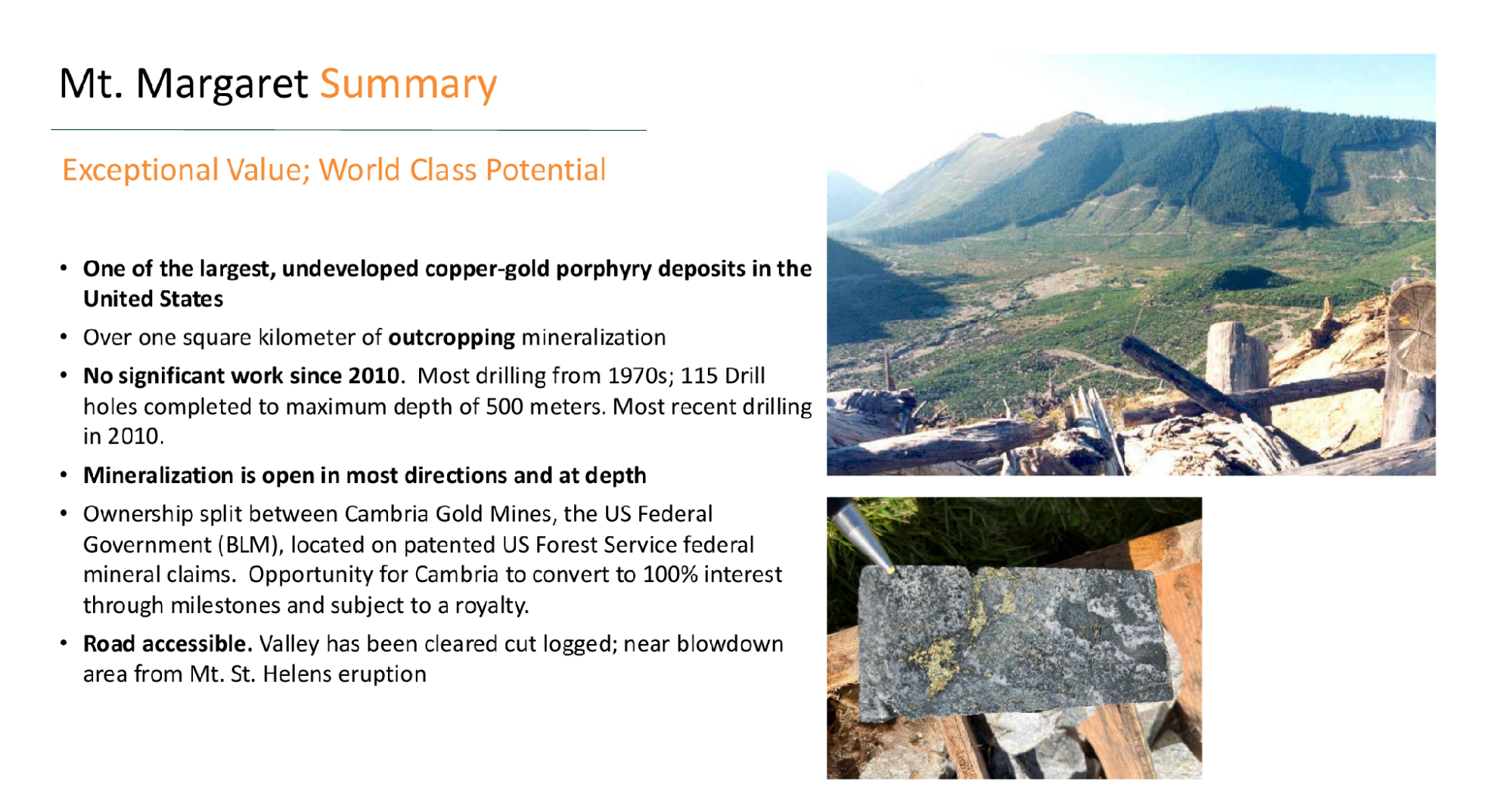
The company says the deposit has more than one square kilometer of outcropping mineralization at surface, and Cambria Gold Mines Inc. (TSXV:CAMB) (OTCQX:CAMVF) notes it remains open in most directions and below 500 meters.59
The ownership is just as unusual. Cambria Gold Mines Inc. (TSXV:CAMB) (OTCQX:CAMVF) controls 50% of the mineral rights on the patented claims at the heart of the deposit, and the US federal government controls the other 50%.60
Cambria has the right to earn 100% of the property, subject to a 1.5% net smelter royalty and a negotiated federal royalty. It also staked about seven square kilometers of new claims around the deposit this year.61
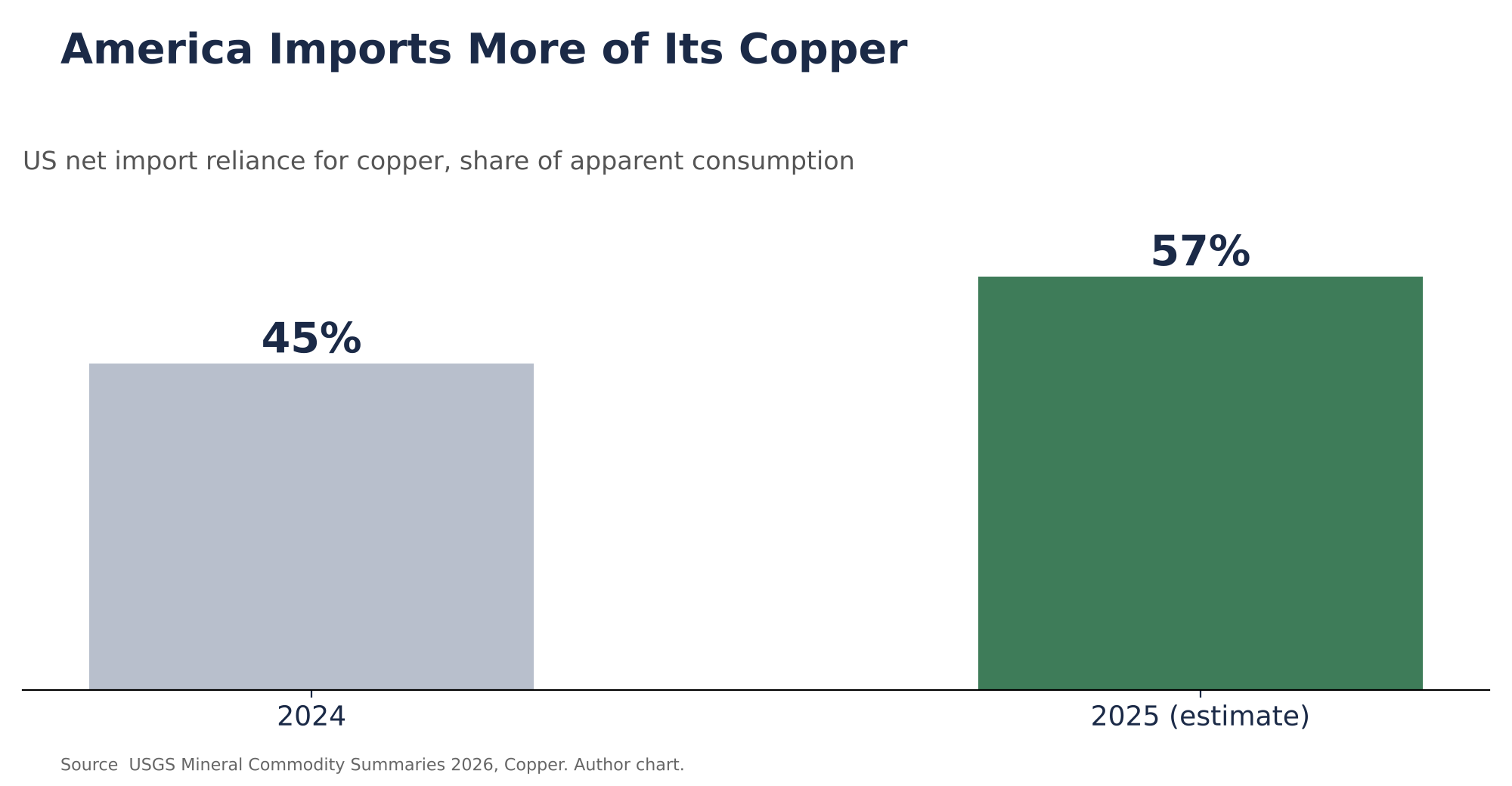
For Cambria, the timing could hardly be better. The US relied on imports for an estimated 57% of its copper consumption in 2025, up from 45% a year earlier,62 and copper was added to the government’s final 2025 list of critical minerals.63
Cambria Gold Mines Inc. (TSXV:CAMB) (OTCQX:CAMVF) is not alone in seeing potential in Washington State, which is proving it can host modern mining.
In January 2026, Kinross approved about US$485 million to restart its Kettle River mill and develop the Curlew underground mine in the state, with first production expected in 2028.64
Natural resources already run deep in the state. Resource extraction accounted for about US$7.2 billion of Washington’s 2024 GDP, and Lewis County, home to Mt. Margaret, is the most active logging region in the state.65
The Mt. Margaret valley Cambria is exploring was clear-cut in the 1990s and the deposit has paved road access, nearby power and access to tidewater.66
Cambria‘s Mt. Margaret project could have another advantage: the federal FAST-41 permitting process. Designed to cut through lengthy permitting delays, FAST-41 offers qualifying mining projects a more coordinated review process, clearer timelines and a more predictable path toward development.67
Cambria Gold Mines Inc. (TSXV:CAMB) (OTCQX:CAMVF) had planned to spin Mt. Margaret out into a separate US company. In September, the company changed course and decided to keep it, citing the asset’s Tier 1 potential, talks with strategic partners and feedback from its own shareholders.68
The US team at Cambria is now advancing permit applications and environmental studies for new exploration drilling.70 The first deep holes into a system that is open below 500 meters could be some of the most important news the company ever releases.
The People and the Money Behind the Restart
Cambria Gold Mines Inc. (TSXV:CAMB) (OTCQX:CAMVF) is not a lone management team hoping for the best. Its largest shareholder is Ccori Apu, a family-owned mining investment group, which holds about 36%.71
Ccori Apu, Franklin Templeton and the Fiore Group together control over 50% of the company. That is a tight, committed shareholder base for a company of this size.
The rescue itself was substantial. Cambria’s predecessor closed a C$175 million private placement in two tranches by January 27, 2026, part of about C$190 million of equity recapitalization that also included a rights offering.72
Since then, warrant holders have kept writing checks. As of October 5, Cambria Gold Mines Inc. (TSXV:CAMB) (OTCQX:CAMVF) had received more than C$45.9 million from warrant exercises.73
The board and management have been strengthened too. In September, Cambria added retired Major General Kim Colloton, formerly Deputy Chief of Engineers of the US Army Corps of Engineers, to its board.74
It also named Cleve Rueckert, the former Head of Investor Relations at Barrick, as Vice President of Corporate Development.75
And in May, Cambria upgraded its US listing to the OTCQX Best Market to make the company easier for American investors to follow.76
Gold Has Pulled Back. History Says Pay Attention
There is one more reason the timing is interesting. Gold set a record above US$5,500 an ounce in late January 2026 and closed near US$4,172 on October 15, a pullback of about 25%. Cambria Gold Mines Inc. (TSXV:CAMB) (OTCQX:CAMVF) cannot control the gold market, but history offers some perspective.
Pullbacks like this have happened before inside long gold bull markets. Gold fell about 45% in the mid 1970s before setting new records by 1980, and dropped roughly 30% in 2008 before reaching new highs in 2011.77
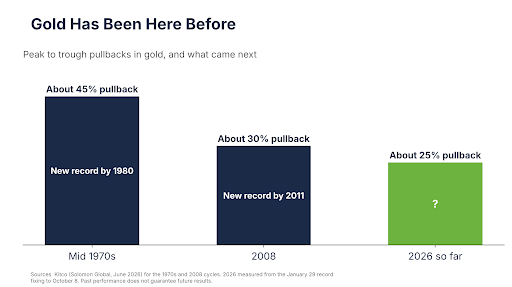
A gold developer like Cambria is not the same as the metal, and nobody can call the bottom of a correction. But a company with a mill already built and a restart planned for late 2027 is positioned to bring ounces to market in whatever gold environment comes next.
What Comes Next for Cambria
The next fifteen months are packed with milestones that can move the story from promise to proof.
- Red Mountain road. Cambria Gold Mines Inc. (TSXV:CAMB) (OTCQX:CAMVF) is aiming to reach Bromley Humps by the end of 2026.
- More drill results. Initial infill results from Silver Coin were expected in October 2026, with drilling continuing through year end.
- Underground development. Upgrades at Premier Northern Lights are due by the end of 2026, with Silver Coin development planned for spring 2027.
- Updated feasibility study. Cambria Gold Mines Inc. (TSXV:CAMB) (OTCQX:CAMVF) is targeting the first half of 2027.
- Mill commissioning. Targeted for the fourth quarter of 2027, with ramp up through 2028.
- Mt. Margaret permitting. Applications and environmental studies for new drilling are being advanced.
The Bottom Line
Somebody already spent more than half a billion dollars building this gold mine complex. The company that owns it today was valued at a fraction of that in mid October.
Cambria Gold Mines Inc. (TSXV:CAMB) (OTCQX:CAMVF) has a mill, a permitted project at Premier, a Measured high grade resource at Red Mountain with its EA and EIS approvals, a road under construction and a team led by a man whose family has worked these deposits for three generations.
It also holds a US copper gold porphyry that a volcano put on hold for three decades, with the right to earn 100%, at a time when US copper import reliance has jumped to an estimated 57%.
Developers like Artemis and Skeena were valued at well under a billion dollars at the end of 2022. Cambria is targeting its own restart in the fourth quarter of 2027.
For investors who want to be watching before that happens, now is the time to put Cambria Gold Mines Inc. (TSXV:CAMB) (OTCQX:CAMVF) on the radar.