Not every drill campaign hits like this.
And not every junior can say they just unveiled a copper-gold intercept that turns a well-known deposit into something far more valuable.
But that’s exactly what happened with Abitibi Metals Corp. (CSE:AMQ) (OTCQB:AMQFF) this week.
In a freshly reported drill hole labeled 1274-17-269W5, the company struck one of the highest-grade copper-gold hits the Abitibi Greenstone Belt has seen in years. A total of 17.91% copper equivalent (CuEq) over 6.3 metres, composed of 13.48% copper and 5.15 g/t gold, sitting within a broader 19.5 metre envelope grading 6.93% CuEq.
That’s not incremental progress. That’s a major step-change.
It’s the kind of hit that can redefine how the B26 deposit is valued and understood.
And here’s why that matters…
This Was Supposed to Be About Copper. Then the Gold Showed Up.
The original goal was to follow up on high-grade copper intercepts drilled previously in this same corridor. Two earlier holes, 1274-17-260 and 1274-17-269, had already delivered promising results, including 2.4% CuEq over 10 metres and 2.7% CuEq over 12 metres.
Those numbers alone put B26 firmly in the upper tier of undeveloped copper projects in Canada.
But the wedge hole 269W5 broke through that ceiling.
Not only did it confirm continuity of copper mineralization in this structural zone, it revealed a much stronger gold component than expected. The result was a bonanza-grade intercept with the kind of multi-metal upside that can shift a deposit’s development trajectory.
Because when you move from 2% CuEq to nearly 18% CuEq over meaningful widths, the economics change and so does the interest from major players.
Why These Numbers Matter Right Now
Context is everything.
The current copper market is stretched thin. The red metal is trading near $10,740 per ton or about $4.87 per pound, and some analysts are now calling for a move toward $12,000 per ton amid mounting supply deficits.
Inventories are scraping 15-year lows. New projects are delayed. And the demand from electric vehicles, grid infrastructure, AI data centers, and clean energy applications is accelerating.
But copper is not the only headline.
Gold just hit $4,073 per ounce, approaching all-time highs, as capital rotates into hard assets in response to inflation, geopolitical tension, and central bank stockpiling.
What happens when a single drill hole hits material amounts of both metals in the same interval?
It raises the value per tonne. It adds flexibility to future development strategies. And it puts the project in front of an entirely different audience — one that includes major copper producers, gold majors, and hybrid base-precious metal players looking for scale, grade, and optionality.
It’s Not Just the Grades. It’s the Setup.
Abitibi Metals is not just exploring. They’re de-risking.
The B26 deposit is a historical discovery with over 80,000 metres of legacy drilling and an existing resource foundation. But what the company is doing now is more than infill. It’s expansion. It’s reinterpretation. It’s targeting zones where the old model missed the real upside.
And it’s working.
The presence of bonanza CuEq zones in wedge hole 269W5 suggests that this system may host high-grade shoots that were previously overlooked or under-modeled.
That’s significant because these kinds of shoots can materially lift the grade of a deposit and the valuation that goes with it.
Press Releases
- Abitibi Metals Expands Western Down-Plunge Zone with 150m Step-Out, Intersecting 2.71% CuEq over 7m within 1.81% CuEq over 15m
- Abitibi Metals Achieves Early Exercise of B26 Option, Securing 80% Ownership of the High-Grade Copper-Gold Project in Quebec
- Abitibi Metals Delivers Significant Increase in B26 Mineral Resource, Advancing to 13.0 Mt Indicated at 2.1% CuEq and 12.3 Mt Inferred at 2.2% CuEq
- Abitibi Metals Continues to Expand High-Grade Copper-Gold Mineralization in the Western Down-Plunge, Highlighted by 12.83% CuEq over 5m
- Abitibi Metals Appoints Proven Mine Builder and Operator David Bernier as Chief Operating Officer
Quebec Is Not the Middle of Nowhere
Location still matters in mining. The Abitibi Greenstone Belt is one of the most productive mining regions in the world.
It is home to world-class infrastructure, low-cost power, paved road access, and a deep talent pool. It’s also a jurisdiction that is consistently ranked as a top destination for exploration investment.
This isn’t the Arctic. It’s not a far-flung jungle or high-altitude desert. It’s an operating environment where discoveries can translate to development timelines that actually make sense.
And that’s part of what makes B26 such a compelling story.
You don’t need to imagine a road, powerline, or rail link. They already exist. You don’t need to fly in equipment on a helicopter. You can drive it in on a highway.
Institutional Capital Is Already Here
A lot of juniors struggle to attract serious capital. That’s not the case here.
Abitibi Metals is already backed by BMO Capital Markets, one of Canada’s most respected mining institutions. The company has also attracted support from Delbrook Capital and other prominent names in the space.
But what really separates Abitibi from the rest is the insider commitment.
Since January, insiders have added more than 4.5 million shares, both in open market buys and private placements. Management now holds 16% of the company, while the Deluce family controls an additional 10%. Combined with continued buying from Keith and Jonathon Deluce, this group now represents one of the strongest aligned ownership blocks in the sector, supported further by high-net-worth and strategic shareholders (15%), SOQUEM Inc. (7%), institutional investors (24%), and a tight 23% public float.
That’s not a promotional stake. That’s real conviction.
And when insiders are that aligned, and buying at the same prices as retail, it signals belief in what’s coming next.
The Historical Comparison That’s Hard to Ignore
No two deposits are the same, but there’s a pattern forming that can’t be ignored.
Foran Mining, a small junior with a VMS-style copper-gold system in Saskatchewan, spent years proving up a known asset called McIlvenna Bay.
In 2016, Foran traded near $0.10 per share, with limited volume and visibility.
Then they got aggressive. They drilled hard. They released results that showed continuity, scale, and grade. Institutional money followed.
Today, Foran trades near $3.78 with a market cap close to C$2 billion.
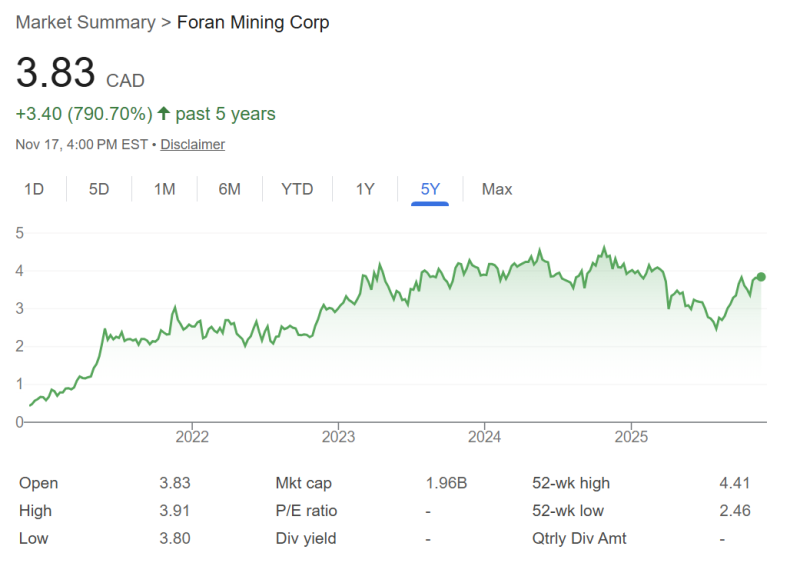
Abitibi is at the earlier stage of that same arc, but the ingredients are familiar:
- Strong historical database
- New management team with capital and strategy
- Tight share structure
- World-class jurisdiction
- New drill hits that redefine the narrative
Foran proved what happens when you drill into a known system and find more than expected. Abitibi may now be doing the same and at just the beginning of their rerate.
A Tight Share Structure With Torque
With similar shares outstanding as Foran before their big discovery, and with over 30% held by management and insiders, this is pretty tightly held.
That matters.
Because when you combine that with a rising commodity backdrop, new bonanza-grade intercepts, and institutional interest already in play, the torque on each new result is magnified.
In other words, less dilution and more leverage to every dollar added to project value.
This Is Not the End of the Story
What’s important to understand here is this:
Hole 269W5 may have just opened the door to a much bigger system than previously modeled. The bonanza CuEq grades, the rich gold credit, and the confirmation of high-grade shoots suggest that the current resource may only be scratching the surface.
Drilling is ongoing. Results are still to come. And if even a few more holes hit similar grades, the updated resource could shift dramatically.
That’s the kind of scenario that doesn’t just move a stock. It changes the conversation.
Where This Goes Next
The next phase of the campaign will focus on:
- Expanding high-grade zones around hole 269W5 and its surrounding intercepts
- Testing strike extensions and new EM targets within the 10km corridor
- Tightening up the model ahead of an updated resource
- Evaluating the gold system potential, now that multi-gram gold hits are confirmed
This is a story still unfolding, but it’s no longer theoretical.
The copper is there. The gold is there. And the market conditions are shifting in their favor.
We encourage you to do your own due diligence and review the full corporate deck, which outlines the drill plan, asset history, capital structure, and upcoming catalysts in detail.
Get the investor presentation here.
If you’re following the copper and gold trade, and you’re looking for exposure to a junior that just turned the lights on with bonanza grades in Quebec, Abitibi Metals Corp. (CSE:AMQ) (OTCQB:AMQFF) is one to watch closely.
*All figures in CAD unless otherwise stated.
Full Disclaimer
The B26 Project is at an early stage of exploration & resource development and does not currently have a mineral reserve estimate, feasibility study, or demonstrated economic viability. Any references or comparisons to other mineral projects including Foran Mining’s McIlvenna Bay are intended solely to illustrate potential geological analogues. Such comparisons should not be interpreted as implying that the B26 Project will achieve similar results, development timelines, or economic outcomes.
Projects at more advanced stages may have completed technical studies, established mineral reserves, or be under development or in production, which differentiates them from early-stage exploration assets. There is no guarantee that the B26 Project will advance to a similar stage.